Sachsen Wine Region: Germany’s Rarest Wine Country Along the Elbe
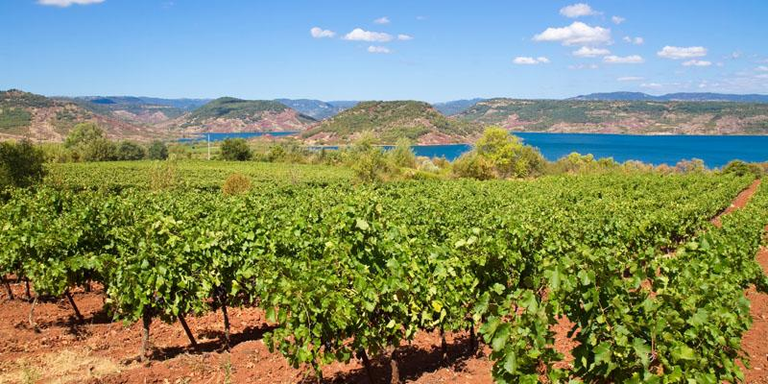
Most wine lovers can place Mosel, Rheingau, or Pfalz on a map without thinking twice. Sachsen is a different story. Tucked into the far east of Germany, wrapped around the Elbe River between Pirna and Diesbar-Seußlitz, this is the country’s smallest classified wine region and one of the northernmost vineyard areas on earth. Fewer than 500 hectares are under vine here, a fraction of what Rheinhessen or Pfalz produce in a single village. Yet the wines coming out of Saxony today, particularly the dry whites from granite and gneiss slopes above Dresden and Meissen, are quietly building a reputation among growers, sommeliers, and travelers willing to go off the well-worn Riesling trail.
©Borisb17 / www.shutterstock.com
This The Pairing Passport guide covers the history, geology, and grape varieties that make Sachsen unlike anywhere else in Germany, along with four wineries worth building a trip around, food pairing notes, and honest advice on where to actually find these wines once you are back home.
Where Sachsen Sits on Germany’s Wine Map
Sachsen occupies a narrow 40-kilometer stretch of the Elbe valley, running from Pillnitz on the outskirts of Dresden northeast to the village of Diesbar-Seußlitz, just past Meissen. The whole region sits at roughly 51 degrees north latitude, making it one of the coldest and most marginal wine climates in Europe outside of England and southern Scandinavia.
Officially, Sachsen is divided into three Bereiche: Elstertal, Meissen, and Dresden. In practice, almost everything a visitor will taste and see is concentrated between Pirna, Dresden, Radebeul, and Meissen, a compact area that can genuinely be explored on a long weekend without much driving.
The region covers just over 490 hectares, putting it ahead of only Mittelrhein and Hessische Bergstraße in size among Germany’s thirteen quality wine regions. Roughly 3,650 growers work these vineyards, but the vast majority are small-scale or part-time, farming plots that have been passed down for generations. Three larger producers, the Sächsische Winzergenossenschaft Meißen cooperative, the state-owned Schloss Wackerbarth, and the private estate Schloss Proschwitz, account for the bulk of what actually reaches a bottle.
A Short History of Vines Along the Elbe
Viticulture in Saxony dates back to at least 1161, when documents first mention wine growing near Meissen. By the 17th century, roughly 5,000 hectares were planted here, ten times the current footprint, and Meissen was considered the cradle of Saxon winemaking, a status the city still celebrates every year with its regional wine festival.
The 20th century was not kind to Saxon wine. Phylloxera, two world wars, and forty years of collectivized agriculture under East German rule reduced the region to a shadow of its former self. Many family estates were expropriated after 1945, their owners either deported or forced into exile. Weingut Schloss Proschwitz is the clearest example: the zur Lippe family, who had made wine in Saxony for over 300 years, lost everything when Soviet forces occupied the region.
Reunification in 1990 changed the trajectory entirely. Growers who had been farming grapes for state cooperatives suddenly had the freedom to bottle under their own names, replant on better sites, and reinvest in quality. Georg Prinz zur Lippe began buying back his family’s land parcel by parcel starting in 1990, eventually restoring both the Proschwitz castle and its surrounding vineyards. Klaus Zimmerling planted his first vines in Pillnitz two years later. That generation of post-reunification growers built the reputation Sachsen enjoys today, one built on quality over volume, since the region will never compete on scale with Rheinhessen or Pfalz.
Grapes and Terroir: Why Sachsen Tastes Different
Roughly 80 percent of what grows in Sachsen is white, and the varietal mix tells you a lot about the climate. Müller-Thurgau and Riesling lead, followed closely by Weissburgunder (Pinot Blanc) and Grauburgunder (Pinot Gris). Traminer performs particularly well on the region’s steepest slopes, and Kerner shows up frequently too.
The one grape that belongs entirely to Saxony is Goldriesling, a crossing of Riesling with Courtillier Musqué that originated in French Alsace but found its true home here. It produces fresh, slightly exotic wines with a gentle muscat lift, unlike anything else in the German canon. Elbling, more commonly associated with the Mosel, also has a small but dedicated following in Sachsen, typically vinified into crisp still wines or the base for sparkling Sekt.
On the red side, Spätburgunder (Pinot Noir), Frühburgunder, Dornfelder, and Portugieser all appear, though reds remain a minority. Sekt production, both traditional method and tank method, has become a genuine specialty, helped by the region’s naturally high acidity.
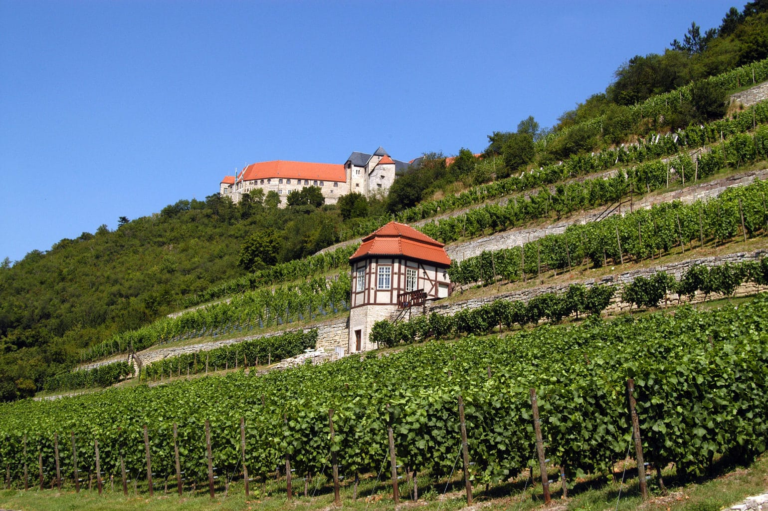
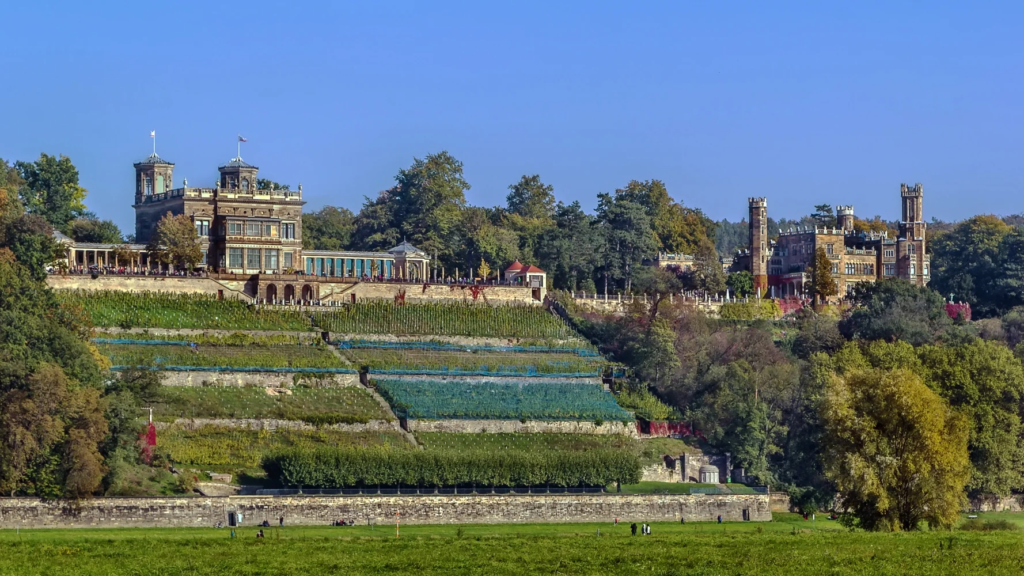
Soil is where Sachsen earns its distinct character. The steepest sites, many of them hand-terraced with dry stone walls that date back centuries, sit on weathered granite and gneiss. Lower slopes carry loess, sand, and clay deposits several meters deep in places. That granite base gives the Pinot family of grapes, and especially Traminer, a mineral backbone that is hard to find elsewhere in Germany. The Elbe itself plays a moderating role too, reflecting sunlight back onto the vines and buffering the otherwise harsh continental winters.
Because ripening happens so far north and so late in the season, yields are naturally low, and acidity stays high. The resulting wines tend to be lighter in body than their counterparts from Rheinhessen or Baden, with a certain restraint and precision that reflects the marginal climate they come from.
The Sächsische Weinstraße: Planning Your Route
Holger Stein Fotografie, Dresden – Tourismusverband Sächsisches Elbland e.V.
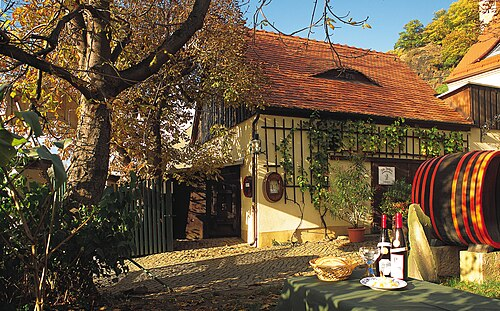
The Saxon Wine Route, or Sächsische Weinstraße, runs 55 kilometers from Pirna through Dresden and Radebeul to the vineyards around Diesbar-Seußlitz near Meissen. A parallel 90-kilometer hiking trail, the Sächsischer Weinwanderweg, threads through the vineyards themselves, connecting viewpoints, wine taverns, and the small stone cellars that dot the hillsides.
Two towns anchor most visits. Radebeul, just northwest of Dresden, is home to Schloss Wackerbarth and several smaller producers, and makes an easy day trip by tram from the city center. Meissen, famous internationally for its porcelain, sits at the northern end of the route and is where Schloss Proschwitz and several historic wine taverns are based.
Late August brings the Tage des offenen Weingutes, the Open Days of Saxon Wineries, when more than 25 estates open their cellars to the public over a single weekend, with a dedicated bus network connecting them so visitors can leave the car behind entirely. Outside of that weekend, most of the wineries below welcome visitors year-round by appointment or during posted opening hours, and Straußwirtschaften, the seasonal wine taverns run by small growers, pop up throughout the warmer months.
Four Wineries Worth the Detour
Schloss Wackerbarth, Radebeul
Schloss Wackerbarth is Saxony’s state-owned winery and, by some distance, its most visited. The baroque estate was built in the early 18th century as a pleasure palace and has produced sparkling wine on the site for over 250 years. It is also the most visitor-friendly stop on this list, with daily tours, a dedicated Sekt manufactory, a restaurant, and a shop stocked with the full range of estate wines.
What sets a visit here apart is the sheer breadth of experience on offer. Beyond a standard tasting, visitors can join guided tours of the sparkling wine cellars, watch the traditional method riddling process in action, or book a vineyard walk through the estate’s own parcels overlooking the Elbe. For anyone new to Sachsen, this is the logical first stop, since it offers the clearest overview of the region’s grape varieties and styles in one place.
Practical details: Wackerbarthstraße 1, 01445 Radebeul. Open daily, with guided tours running on a fixed schedule and reservations recommended in peak season.
Schloss Proschwitz, Zadel bei Meissen
Schloss Proschwitz is Saxony’s oldest and largest privately owned wine estate, and its story is inseparable from the region’s post-reunification revival. Georg Prinz zur Lippe rebuilt the family property from nothing after 1990, eventually restoring both the castle and roughly 70 hectares of vineyard across three main sites: Schloss Proschwitz, Kloster Heilig Kreuz, and Seußlitzer Closterberg. It is Sachsen’s only VDP-classified estate, a mark of quality that puts it in the same tier as Germany’s most respected producers elsewhere in the country.
The estate sits above Meissen with sweeping views over the Elbe and the city’s cathedral. A vinotheque in the castle courtyard handles tastings, and the on-site restaurant, Lippe’sches Gutshaus, is worth booking ahead for dinner paired with estate wines. Tours typically combine a walk through the castle grounds, a look at the working cellar, and a guided tasting, and can run several hours if arranged in advance.
Practical details: Schloss Proschwitz, Heiliger Grund 2, 01665 Zadel. Vinotheque open regular hours with guided tours available by appointment.
Weingut Klaus Zimmerling, Dresden-Pillnitz
Klaus Zimmerling is the estate most likely to come up when serious German wine collectors talk about Sachsen. Founded in 1992 on just 4.5 hectares in Pillnitz, the estate was admitted to the VDP in 2010 and has built a cult following for its handcrafted, low-intervention Riesling, Weissburgunder, and Grauburgunder, all grown on weathered granite in the Pillnitzer Königlicher Weinberg vineyard.
Zimmerling farms organically and presses everything in old Italian basket presses at very low pressure, taking only a single pressing per batch. Yields are deliberately kept low, and the wines typically carry a touch of residual sweetness balanced against firm acidity, a house style that sets them apart from the drier norm elsewhere in the region.
The visit itself is unusual in the best way. Zimmerling’s wife, the sculptor Malgorzata Chodakowska, has filled the vineyard and tasting room with her bronze figures, turning a wine visit into something closer to an open-air gallery. The vinotheque is open during regular hours, with private tours available by arrangement, and bottles can be ordered online directly after a visit.
Practical details: Bergweg 27, 01326 Dresden-Pillnitz. Vinotheque open during posted hours; tastings and cellar tours by appointment.
Vincenz Richter, Meissen
For a sense of Sachsen’s deeper history, Vincenz Richter in Meissen is worth the stop. This is one of the private estates that played a defining role in reviving Saxon wine after German reunification, and it also revived the Sachsenkeule, the distinctive regional bottle shape once nearly lost to time. The estate operates out of a historic half-timbered building in Meissen’s old town, combining a working winery with a restaurant and small wine museum in the same complex.
It is a smaller, more rustic experience than Wackerbarth or Proschwitz, closer to the Straußwirtschaft tradition of family-run hospitality, and a good way to end a day that started at the grander estates further south. The location in central Meissen also makes it an easy add-on to a visit to the town’s cathedral and famous porcelain manufactory.
Practical details: Vincenz Richter, An der Frauenkirche 12, 01662 Meißen. Restaurant and wine shop open regular hours; check ahead for cellar visit availability.
What to Eat With Sachsen Wine
Saxon cuisine leans hearty and regional, and it pairs naturally with the wines grown just up the hill. Sächsische Sauerbraten, a slow-braised beef dish with a slightly sweet and sour sauce, works well with the region’s Spätburgunder or Frühburgunder, which have enough acidity to cut through the richness without overwhelming it.
For the whites, keep it simple. A dry Weissburgunder or Grauburgunder from granite soil pairs naturally with Elbe River fish, particularly pike-perch (Zander), a local specialty often served pan-fried with a light butter sauce. Goldriesling, with its aromatic lift, is a strong match for Saxon Christmas stollen out of season, or with fresh soft cheeses and stone fruit in summer.
Sekt from Schloss Wackerbarth or Proschwitz deserves a place at the table too, not just as an aperitif. Traditional method Sekt with some bottle age has enough structure to stand up to Dresden’s classic Eierschecke, a layered cheesecake that is far less sweet than it sounds and benefits from a wine with real acidity alongside it.
Where to Buy Sachsen Wine Online
This is where honesty matters more than convenience. Sachsen represents roughly one percent of German wine production, and almost none of it leaves the region, let alone the country. Retailers that stock a broad range of German wine, including Wijnbeurs, Colaris, and Decantalo, generally do not carry Sachsen bottlings, simply because the volumes involved are too small for international distribution to make commercial sense.
The most reliable way to actually taste these wines is to order directly from the estates. Schloss Wackerbarth ships within Germany and to several neighboring countries through its own webshop, and its Sekt range is the most widely distributed style from the region, occasionally turning up at specialist German wine merchants outside the country. Schloss Proschwitz and Klaus Zimmerling both sell bottles directly through their estate websites as well, and ordering ahead of a visit, or arranging to have a case shipped after a tasting, tends to be the surest route to bringing these wines home.
If a trip to Dresden or Meissen is not on the calendar any time soon, specialist German wine importers and online sommelier platforms are worth checking periodically, since a small number of Sachsen bottles do occasionally surface through channels that focus specifically on rare or boutique German producers. For anyone building a serious German wine collection, treat a Sachsen bottle the way you would treat a small grower Champagne: worth chasing down, but not something to expect on a standard retailer’s shelf.
Best Time to Visit
Late spring through early autumn is the easiest window for a Sachsen wine trip. May and June bring flowering vines and mild weather without the summer crowds that Dresden’s other attractions pull in. September and early October coincide with harvest, and many smaller growers open informal Straußwirtschaften serving new wine (Federweisser) alongside simple food.
The last weekend of August, when the Open Days of Saxon Wineries take place, is the single best window for anyone who wants to see multiple estates in a short trip, since the connecting bus network removes the usual logistics headache of visiting several rural producers in one day.
Winter has its own appeal for a different kind of trip. Dresden’s Striezelmarkt, one of Germany’s oldest Christmas markets, runs through December, and several wineries pour mulled Glühwein made from their own grapes, a nice bridge between the wine region and the city’s other seasonal draw.
Practical Travel Tips
Dresden makes the obvious base. Its airport has direct connections to several European hubs, and the city itself, rebuilt with remarkable care after wartime destruction, is worth two or three days on its own before heading into the vineyards. Radebeul is a short tram ride from central Dresden, making Schloss Wackerbarth an easy half-day trip without a rental car.
Meissen sits about 25 minutes from Dresden by regional train, and Schloss Proschwitz and Vincenz Richter can both be combined with a walk through the old town and a visit to the porcelain manufactory, which offers its own factory tours. A rental car opens up the smaller, harder-to-reach growers along the Weinstraße, particularly around Diesbar-Seußlitz, but is not strictly necessary if the goal is to focus on the four estates covered here.
Book tastings and tours in advance where possible, especially at Proschwitz and Zimmerling, since both are working estates first and tourist attractions second. German is the primary language at most smaller producers, though the larger estates, particularly Wackerbarth, are well set up for English-speaking visitors.
A Region Worth the Detour
Sachsen will never be a household name the way Mosel or Rheingau are, and that is precisely what makes it worth the trip. This is a region where the wine, the history, and the landscape are still tightly bound together, where a granite terrace planted eight centuries ago sits a short walk from a working cellar rebuilt by hand after decades of neglect. Visiting is the only reliable way to taste the full range of what Saxon growers are doing, and it turns a wine trip into something closer to a genuine discovery, a rarer thing than it should be in European wine travel today.