Puglia Wine Region: Primitivo, Negroamaro, and Where to Visit in Southern Italy
Southern Italy has no shortage of wine regions with serious credentials, but few feel as raw, sun-baked, and genuinely rewarding to explore as Puglia. Stretching down the heel of the Italian boot between the Adriatic and Ionian seas, this long, flat region produces more wine than almost anywhere else in the country, and for most of its history, the vast majority of it was quietly shipped north to bulk out blends in cooler regions or feed the vermouth industry in Piemonte. That story has changed dramatically. Over the past two decades, a generation of producers has chosen to bottle under their own name, cut yields in old alberello (bush vine) vineyards, and push quality over volume. The result is one of the most exciting value propositions in European wine today.
This is not a beginner’s region. The wines are structured, warm, and sometimes demanding. The landscape rewards the traveller who gets off the main tourist routes. And the indigenous grapes, once dismissed as workhorses, are now recognised as genuinely distinctive varieties with serious ageing potential. If you know your Salice Salentino from your Primitivo di Manduria, or you’re simply ready to go deeper than the tourist trail, Puglia deserves a place at the top of your list.
Understanding the Region: Geography and Terroir
Understanding the Region: Geography and Terroir
Puglia runs for around 400 kilometres along the Adriatic coast, from the Gargano promontory in the north all the way down to Leuca at the very tip of the heel. The region divides into three broad sub-zones: Foggia and the Daunia in the north; the Trulli country and the Valle d’Itria in the centre; and the Salento peninsula in the south.
It is predominantly flat to gently rolling, with the Murgia plateau providing the most significant elevation, enough to bring cooler nights that help preserve acidity in the wines. The soils are complex and varied. You find calcareous clay, iron-rich red earth known locally as *terra rossa*, and the distinctive white limestone (*tufo* and *carparo*) that characterises the Salento. This limestone retains moisture during the long dry summers, acting as a natural irrigation system for the old bush vines.
The climate is Mediterranean: long, hot, dry summers with reliable sun, moderated by sea breezes from both the Adriatic and Ionian coasts. Rainfall is concentrated in winter and spring. This is genuinely one of the warmest wine-producing areas in Italy, with average summer temperatures in the Salento regularly exceeding 35°C. The consequence is wines with natural warmth, generous fruit, and alcohol levels that typically sit between 13.5% and 16%. The best producers manage this through careful canopy management, early picking where appropriate, and by farming old alberello vines whose low yields concentrate flavour without pushing ripeness into jammy excess.
Puglia has four DOCGs and 28 DOC zones. In practice, the labels that matter internationally are Primitivo di Manduria DOC (and its sweet sibling, Primitivo di Manduria Dolce Naturale DOCG), Gioia del Colle DOC, Salice Salentino DOC, and Castel del Monte DOC in the north.
The Grapes: What to Know Before You Visit
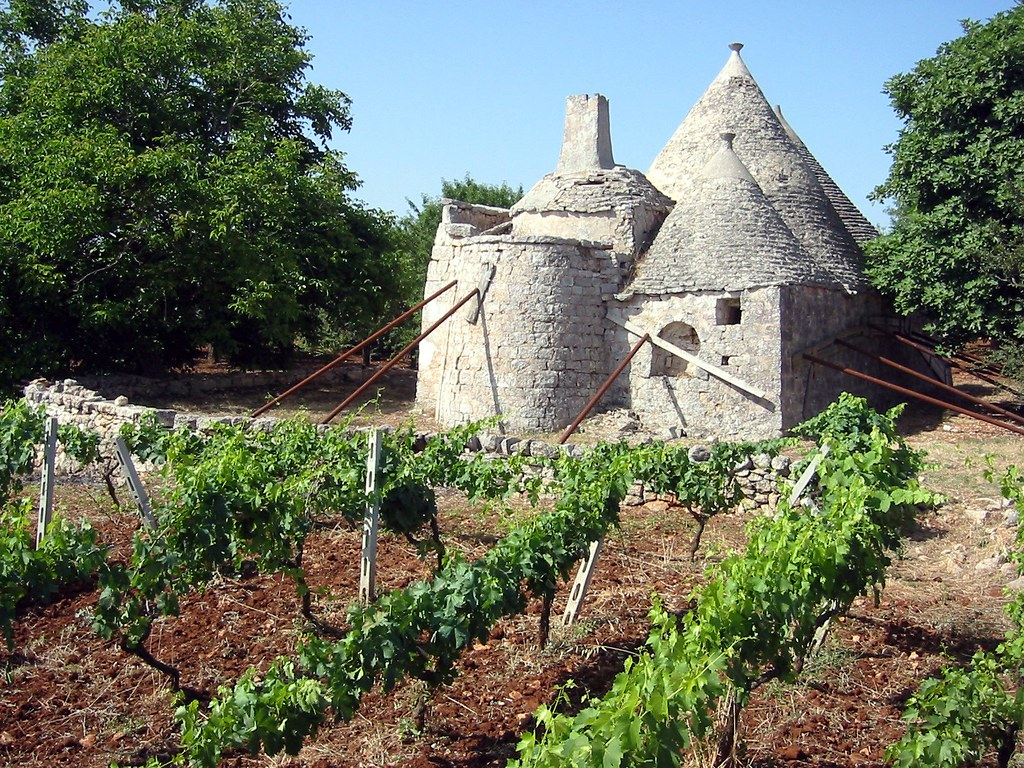
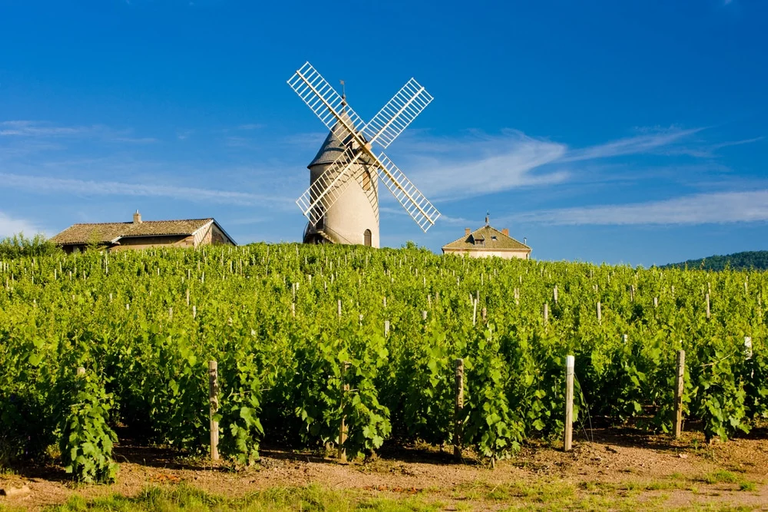
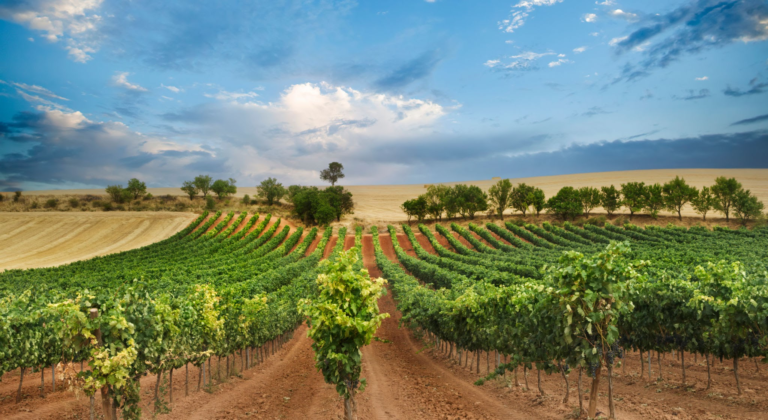
“Vineyard” by jasonrumney.net is licensed under CC BY-NC-SA 2.0 


 .
.
Primitivo
Primitivo is the grape that put Puglia on the map for international buyers. It is genetically identical to California’s Zinfandel, with both varieties tracing their origins to the Croatian grape Tribidrag. In Puglia, it produces wines with a distinctly different character from its New World counterpart: darker, more savoury, with a spicy edge to the fruit and a long, warming finish rather than the jammy sweetness typical of big Californian Zinfandel.
The benchmark for Primitivo is the Primitivo di Manduria DOC, centred on the town of Manduria on the Ionian coast south of Taranto. Here, old alberello vines on deep calcareous soils produce wines of real concentration and complexity. The style ranges from dry and structured to the rare and beautiful Dolce Naturale, a naturally sweet, lightly fortified version that is one of southern Italy’s most distinctive dessert wines. Outside Manduria, excellent Primitivo is also produced in the Gioia del Colle DOC on the Murgia plateau, where higher altitude gives the wines more freshness and tension than the coastal versions.
Expect aromas of black cherry, dried fig, tobacco and dark chocolate, with a warm, spiced palate and tannins that are firm in youth but round out with bottle age.
Negroamaro
Negroamaro is the Salento’s other major variety, and for many serious drinkers it is the more interesting of the two. The name translates as “black bitter”, an accurate description of its character: deeply coloured, with dark berry fruit, dried herbs, tobacco, and a distinctive bitter-almond note on the finish that keeps the wine fresher than you might expect from such a warm growing environment. That salinity and bitterness make it surprisingly versatile at the table, working as well with grilled fish as it does with lamb or slow-cooked meat.
Negroamaro is the backbone of Salice Salentino DOC, one of southern Italy’s most reliable and underpriced everyday reds, where it is typically blended with a small percentage of Malvasia Nera to add softer texture. It also produces some of the finest rosato in Italy. Puglia has been making serious rosé since the 1940s, long before the style became fashionable, and the best examples have real depth and structure rather than the pallid, commercial simplicity that dominates the category elsewhere.
Nero di Troia
Less well known internationally but increasingly worth seeking out, Nero di Troia (also called Uva di Troia) is the dominant red variety in northern Puglia, particularly around Castel del Monte DOC. It makes structured, tannic wines with floral perfume, blue and dark fruit, and a savoury mineral character. At its best, it is genuinely noble, complex enough to age well and distinctive enough to stand apart from the southern Puglia style.
White Varieties
Puglia is predominantly a red wine region, but the whites deserve attention. Verdeca and Bianco d’Alessano, both cultivated in the Valle d’Itria around Locorotondo and Martina Franca, give dry, refreshing whites with good natural acidity and a pleasing mineral note, a welcome contrast after a day among the reds. Fiano Minutolo (sometimes called Minutolo) is a fragrant, aromatic white producing wines of real elegance in the Salento, while Bombino Bianco is widely grown further north. There is also Muscat-like sweetness to be found in Aleatico, used for Puglia’s small production of red dessert wine.
Puglia’s Appellations: A Short Guide
Primitivo di Manduria DOC / Dolce Naturale DOCG: The Ionian coast south of Taranto. This is Primitivo’s heartland, with old bush vines and the most powerful expressions of the grape. Look for producers with clear single-vineyard or old-vine designations.
Gioia del Colle DOC: On the Murgia plateau inland from Bari. Both Primitivo and Negroamaro are grown here at altitude, giving wines with more lift and freshness than the coastal zones. This is where you find Polvanera’s celebrated cru bottlings.
Salice Salentino DOC: The Salento’s most important appellation for Negroamaro, centred around the town of Salice Salentino in the province of Lecce. The Riserva versions, with at least two years of ageing, are particularly worth seeking out.
Castel del Monte DOC / DOCG: Northern Puglia, in the shadow of Frederick II’s 13th-century octagonal citadel. Three of Puglia’s four DOCGs are here, covering Bombino Nero, Nero di Troia Riserva, and Rosso Riserva. Rivera is the estate that defines this appellation internationally.
Salento IGT: A catch-all designation covering the heel of the boot. Many of Puglia’s most exciting and individual wines are bottled under this label, giving producers the flexibility to work outside the stricter DOC rules.
Four Wineries Worth Visiting
Leone de Castris: Salice Salentino
The oldest continuous wine estate in Puglia, with origins tracing to 1665, Leone de Castris is an essential stop for anyone serious about understanding the region’s history. The estate is set among olive groves and vineyards just outside the town of Salice Salentino, and visits include a tour of the historic cellars, a wine museum, and tastings of the estate’s current releases.
Leone de Castris holds a remarkable place in Italian wine history: it produced the country’s first commercially bottled rosé, the Five Roses Rosato, in 1943. That wine remains in the range today and is still one of the best examples of Pugliese rosato: full-bodied, deeply coloured, with wild strawberry and herbs and the kind of structure that works well at the dinner table rather than just as an aperitif. The estate’s Salice Salentino Riserva and the Donna Lisa single-vineyard Negroamaro are the wines most likely to reward cellaring.
The team speaks excellent English, and the tasting experience here is professional without feeling impersonal. It is worth booking in advance, particularly during the summer months and harvest.
Address: Via Senatore de Castris 26, 73015 Salice Salentino (LE)
Website: leonedecastris.com
Visits: By appointment; contact info@leonedecastris.com
Cantine Polvanera: Gioia del Colle
If Leone de Castris represents the historic Salento tradition, Polvanera shows you what the Murgia plateau has to offer. Situated between Acquaviva delle Fonti and Gioia del Colle, this family estate has been built by Filippo Cassano with a precision and seriousness that has earned it recognition well beyond Puglia. The cellar is one of the most striking in southern Italy: carved eight metres deep into the limestone rock, maintaining a naturally cool and constant temperature that makes it ideal for long barrel ageing.
Polvanera’s wines are numbered according to the altitude at which the vineyards sit; the 14, 16, and 17 series correspond to plots between 400 and 500 metres above sea level. These are not blockbuster southern reds; they are wines with genuine freshness, mineral tension, and the kind of structure that rewards four to eight years in the bottle. The Primitivo 17 from old alberello vines is one of the most precise expressions of the variety you will find in Italy.
Visits range from a simple tasting (from around €25 per person, including a tour of the cellar and five wines paired with taralli and local olive oil) to longer lunches paired with older vintages. All experiences require booking in advance. A car is essential; the estate is not served by public transport.
Address: Contrada Viglione, Acquaviva delle Fonti (BA)
Website: cantinepolvanera.it
Visits: By appointment; various tasting packages from €25 pp
Masseria Li Veli: Cellino San Marco
Set halfway between Lecce and Brindisi in the heart of the Salento, Masseria Li Veli is one of those estates that manages to feel both traditional and impeccably modern at the same time. The property was revived in 1999 by the Falvo family, who had already made their mark in Tuscany with Avignonesi, and they brought that same commitment to quality farming with them. The 33-hectare estate has been certified organic since 2005, with albarello Salentino bush vines planted at high density according to the ancient settonce system.
The variety that sets Li Veli apart is Susumaniello, an ancient Salentino variety that was nearly extinct before a handful of producers committed to reviving it. In the hands of Li Veli, it produces a wine of unexpected freshness and dark berry intensity, very different from Primitivo or Negroamaro and worth the detour alone. The estate also makes fine Negroamaro and a compelling Verdeca white from the Valle d’Itria.
Tours include an explanation of production from harvest through to bottling, finishing with a tasting of current vintages. The masseria building, constructed from the typical local carparo stone, is as beautiful as the wines.
Address: S.P. Cellino-Campi Km 1, 72020 Cellino San Marco (BR)
Website: liveli.it
Phone: +39 0831 618259
Email: info@liveli.it
Produttori di Manduria: Manduria
No visit to the Primitivo di Manduria DOC is complete without stopping at Produttori di Manduria, the oldest cooperative in the region. Made up of around 300 small growers farming 700 hectares of old alberello vines, this cooperative is a genuine institution, and one that was among the first nine Italian wineries to receive sustainability certification in 2018.
What makes a visit here particularly worthwhile is the Museum of Primitivo Wine Culture, housed in 19th-century vaulted cellars built directly into the rock. It traces the rural history of the zone and the evolution of Primitivo winemaking in a way that gives real depth to what you taste in the glass. The wines are reliably excellent, with the Lirica and Elegia bottlings showing what careful yield management and old vines can do with this variety. The Dolce Naturale is worth trying here above all; the cooperative handles the style with a lightness of touch that avoids the syrupy excess that can affect lesser versions.
Address: Via Fabio Massimo 19, 74024 Manduria (TA)
Website: produttori-di-manduria.it
When to Visit Puglia
The best time for a wine-focused visit is May to early June (before the heat becomes punishing and the harvest tourists arrive) or September during harvest. The Salento in particular gets extremely hot in July and August, and many estates operate with reduced staff during the peak summer period; always email ahead before travelling.
Spring visits reward you with the dramatic contrast of the alberello vineyards coming into leaf against the white limestone landscape, with wildflowers covering the verges and olive groves in full blossom. September brings the energy and chaos of harvest, and most estates welcome the chance to share that experience with visitors who are genuinely curious.
Winter is quiet and mild, and while some tasting rooms operate reduced hours, the trulli country around Alberobello and the baroque streets of Lecce are easier to appreciate without the summer crowds.
Getting Around
Puglia has airports at Bari (Karol Wojtyla) and Brindisi (Papola Casale), both well connected from major European hubs. Bari is the natural base for the Castel del Monte, Gioia del Colle, and Valle d’Itria zones. Lecce works better if your focus is the Salento and Primitivo di Manduria.
A car hire is essentially non-negotiable for winery visits. The estates are spread across country roads and provincial tracks that are served poorly or not at all by public transport. The distances are not great; most of the key producers in the Salento are within an hour of Lecce, but you will need your own wheels to reach them, and this also means planning your tastings around a designated driver.
Train connections between Bari, Brindisi, and Lecce are reliable and reasonably fast. For anyone based in one of the main cities and wanting to explore the urban wine bars and restaurants, the train works well; for the vineyards, it does not.
Where to Eat and Stay
The food in Puglia is among the most honest and satisfying in Italy. The emphasis is on local ingredients prepared simply: orecchiette pasta with cime di rapa (turnip tops) and salsiccia; burrata from Andria; friselle (dried bread rounds soaked in local olive oil and covered with ripe tomatoes); raw shellfish from the Adriatic; slow-roasted lamb with wild herbs. Most of this has a natural affinity with Negroamaro and Primitivo; the regional principle of drinking what grows where you eat applies here with particular force.
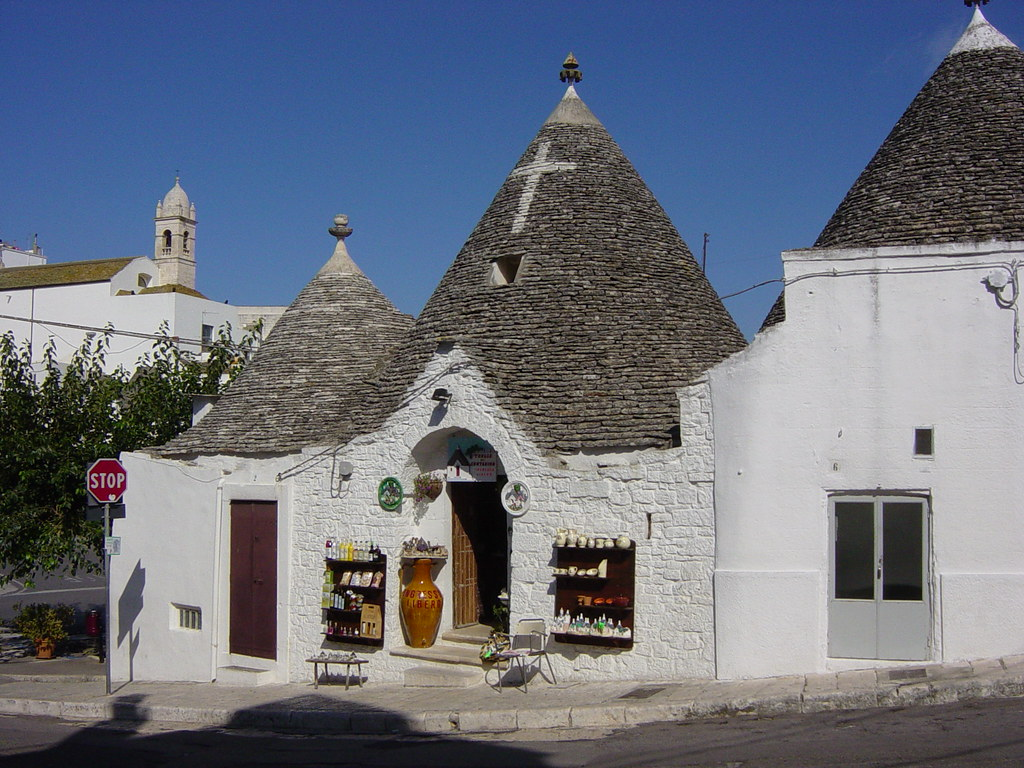
For accommodation, the traditional Pugliese choice is a masseria, a restored fortified farmhouse, many of which have been converted into agriturismo or boutique hotels. Staying at a masseria often means waking up in the middle of a working estate, sometimes with vineyards and olive groves directly outside the door. Borgo Egnazia in Savelletri di Fasano is the most celebrated option, combining world-class service with a genuinely beautiful setting in the Valle d’Itria. For something more intimate, look at the smaller masserias around Manduria and the Copertino area.
Wines to Buy Online
If you can’t make it to Puglia in person, or you want to explore the region before your trip, here are some well-distributed bottles available through the preferred retailers below.
Rosatti Primitivo Puglia: Wijnbeurs
The Rosatti Primitivo is Wijnbeurs’s own-label Pugliese red and represents excellent everyday value. Made from Primitivo grapes grown in the heat of the Salento plain, it delivers ripe black cherry, blueberry, and Mediterranean spice with a soft, round structure and a long, slightly cocoa-tinged finish. At its price point, it is one of the most dependable bottles in the southern Italian category. Find it at wijnbeurs.nl.
Rosatti Negroamaro-Primitivo: Wijnbeurs
Also from Wijnbeurs, this blend combines the warmth and soft fruit of Primitivo with the darker, more savoury character of Negroamaro. The result is a wine with more complexity and texture than a straight Primitivo at this level. Dried herbs, dark berry fruit, a hint of tobacco, and the characteristic Negroamaro bitter-almond note on the finish. It pairs naturally with rich pasta sauces, lamb, and aged southern Italian cheeses. Available at wijnbeurs.nl.
Monbellezio Black Cioccolata Appassimento: Colaris
This appassimento-method Primitivo-Negroamaro blend from Colaris shows the concentrated, denser style that results from partially drying the grapes after harvest. The nose is dense with blueberries, dark plums, black cherries, and unmistakable dark chocolate, with a velvet-smooth structure and a long, lingering finish. At 15% alcohol, it is not a light-evening wine, but alongside a rich braise, slow-roasted lamb, or a cheese board of aged Pecorino, it is exactly what the style promises. Find it at colaris.nl.
Francesco Marra Primitivo: Decantalo
For something more artisan and estate-specific, the Francesco Marra Primitivo available through Decantalo is worth attention. The Marra family farm grows native Primitivo and Negroamaro in clay and ferrous red soils near Ugento, about ten kilometres from the Ionian coast, entirely organically. Grapes ferment spontaneously in wooden vats, and the wine is aged in steel for 18 months before bottling unfined and unfiltered. The result is a Primitivo with real territorial character, wild, a little rustic in the best sense, with dark fruit, mineral depth, and a freshness that the estate’s proximity to the sea seems to encourage. Available at decantalo.com.
Frequently Asked Questions
What are the main wine grapes of Puglia?
The dominant red varieties are Primitivo (genetically the same as California’s Zinfandel), Negroamaro, and Nero di Troia. For whites, Verdeca, Fiano, Minutolo, and Bombino Bianco are the most important indigenous varieties.
What does Primitivo di Manduria taste like?
A well-made Primitivo di Manduria typically shows aromas of black cherry, dried fig, tobacco, and dark chocolate. On the palate, it is full-bodied, warm, and richly textured, with firm tannins that soften after four to six years in the bottle. Alcohol levels commonly sit between 14% and 16%.
Is Negroamaro only a red wine grape?
No. Negroamaro is used to make some of southern Italy’s finest rosato wines, particularly in the Salento. The best examples have real depth of colour, wild strawberry and dried herb character, and the structure to accompany food rather than simply function as an aperitif.
What is the best time to visit wineries in Puglia?
May to early June and September are the most rewarding months. Summer is extremely hot, and many estates reduce their visitor programmes. Harvest in September and early October is an excellent time to see the vineyards in action, but book well in advance.
Can I visit Puglia wineries without a car?
For winery visits, you will almost certainly need a car. The estates are spread across rural roads with no meaningful public transport connection. Lecce and Bari function well as base cities for day trips by hire car, and some tour operators run guided winery excursions that include transport.
Is Puglia wine good value compared to other Italian regions?
Yes, genuinely so. The quality-to-price ratio for Pugliese wine is among the strongest in Italy, particularly for Primitivo di Manduria and Salice Salentino. That gap is narrowing as the region’s reputation grows, but the best estates still offer wines of real ambition at prices well below comparable quality from Tuscany or Piemonte.