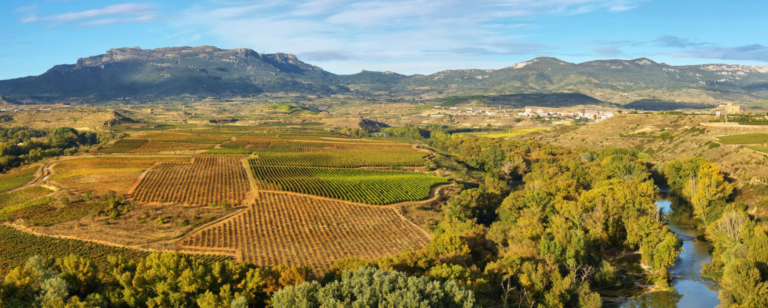
Franken Wine Region: Germany’s Silvaner Country Along the Main River
There is a particular pleasure in arriving somewhere you did not expect to be moved by. Most wine lovers have a mental map of Germany that runs through the Mosel, the Rheingau, maybe the Pfalz, regions that have done a good job of publicising themselves. Franken rarely appears on that map, yet it is one of the oldest and most distinctive wine-producing areas in the country, sitting quietly in the northern tip of Bavaria while the world drinks Riesling.
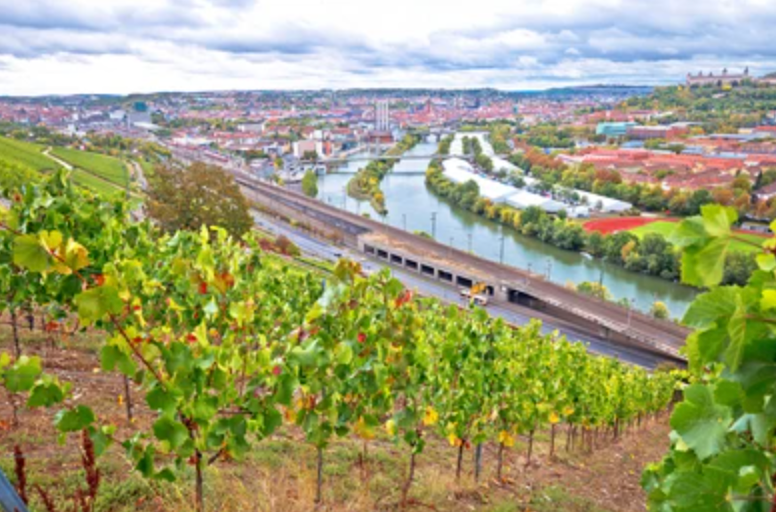
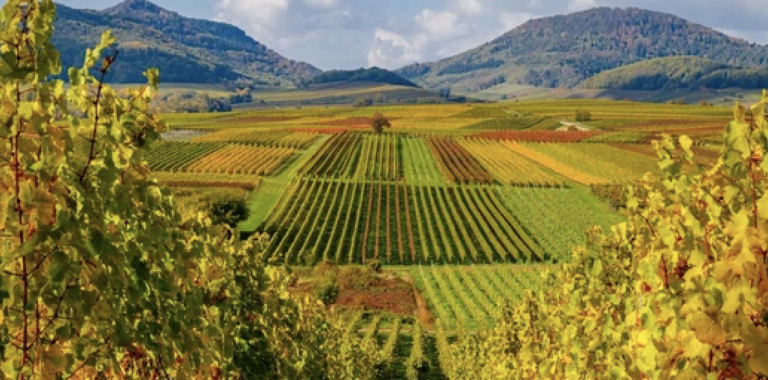
This is Silvaner country. Not the pale, neutral Silvaner that fell out of favour across the rest of Germany decades ago, but a confident, dry, mineral-driven wine shaped by shell limestone soils and one of the most continental climates in German viticulture. The region’s 6,300 hectares of vineyards trace the river Main as it bends in wide loops through Lower Franconia, and the wines they produce have a character so tied to that landscape that they remain stubbornly, gloriously local; roughly four in five bottles never leave the region.
That insularity is both a challenge and an opportunity for wine travellers. You will not find Franken wines on every restaurant list. But when you do track them down, on the terrace of an estate weinstube in Würzburg, or in a bottle carried back from a tasting room in Escherndorf, they tend to stop you in your tracks.
The Lay of the Land
A Region Defined by River and Soil
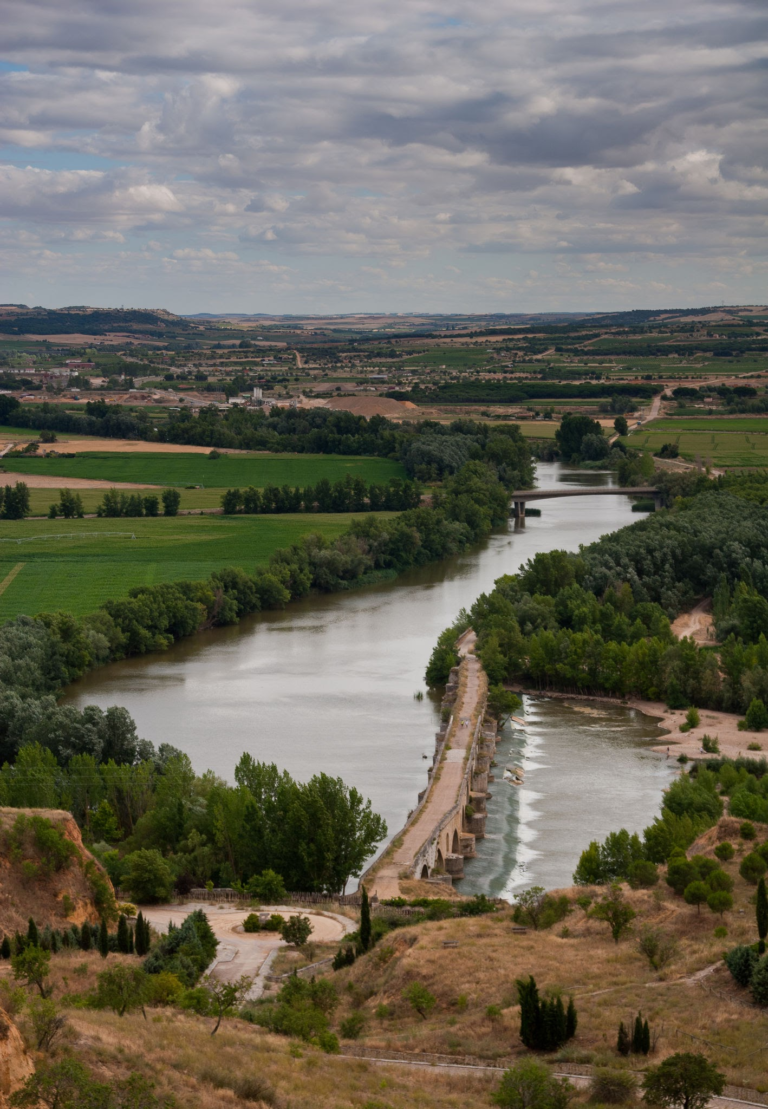
Franken follows the Main River in a rough W-shape across roughly 120 kilometres of Lower Franconia, east of Frankfurt and west of Nuremberg. The region divides into three broad sub-areas, each with a different character.
The Mainviereck is the westernmost stretch, warmer than the rest of Franken and coloured by red sandstone soils. This is where you find Germany’s finest Spätburgunder (Pinot Noir) in the form produced by Weingut Rudolf Fürst, and the dramatic Homburger Kallmuth vineyard cultivated by Fürst Löwenstein. The sandstone here gives red wines a particular iron-tinged depth that has nothing in common with Burgundy but is riveting in its own right.
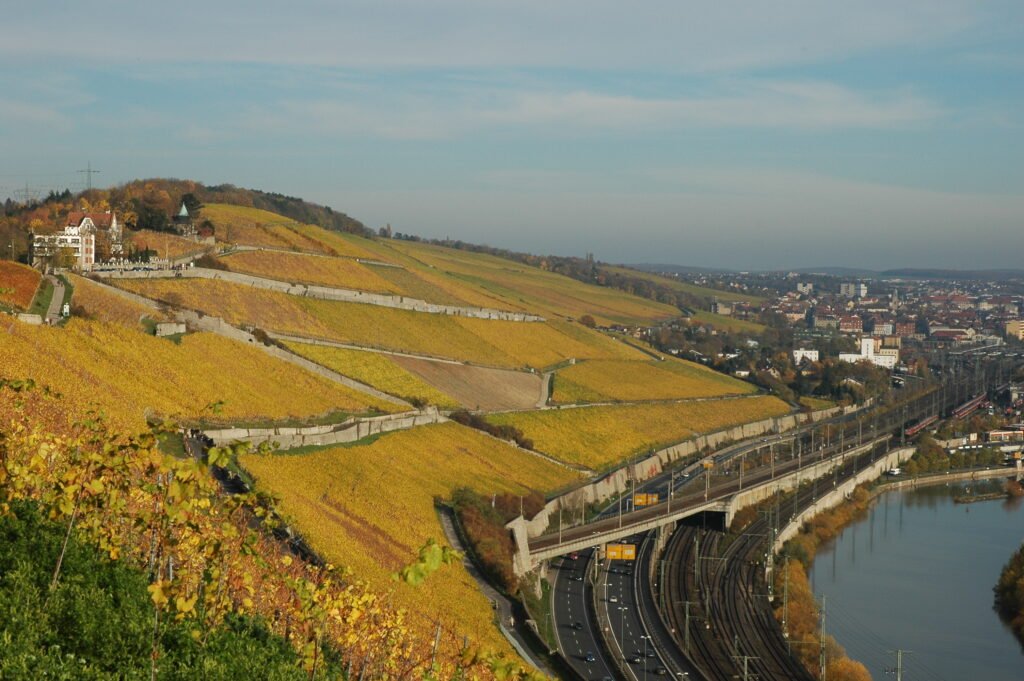
The Maindreieck, the central triangle formed by the looping Main around Würzburg and its surrounds, is the heart of Franken winemaking. The soils here are primarily Muschelkalk, the shell limestone that defines the region’s most iconic whites. Silvaner grown on Muschelkalk has a mineral compression, a savoury spine and a persistent finish that has earned comparisons to white Burgundy from the finest sites. The Würzburger Stein, at 85 hectares the largest single vineyard in Germany, sits just outside the city walls and has been tended by Würzburg’s three great charitable estates for centuries.
The Steigerwald runs along the eastern edge of the region, where soils shift toward gypsum and Keuper. The wines produced here are often weightier, with the kind of herbal and earthy grip that needs food. The town of Iphofen, with its preserved medieval walls and trio of top vineyard sites — Julius-Echter-Berg, Kronsberg and Kalb- is the most important address in this part of the region.
Climate and the Continental Challenge
Franken has a markedly continental climate: cold winters, warm summers, and an autumn that can turn sharply. It is not an easy place to ripen grapes, and vintages vary more than in the warmer western German regions. The best years: 2021, 2020, 2018, and 2015 stand out in recent memory and produce wines of exceptional tension and longevity. In cooler years, acidity is bright, and the wines can need time in the bottle.
What the climate does well is preserve freshness. Franken Silvaner at its best has a mineral intensity and a lively, dry finish that holds up to food in a way that warmer-grown whites rarely manage.
The Bocksbeutel and the VDP
No piece of writing about Franken can avoid the Bocksbeutel, the flat, flagon-shaped bottle that has been the region’s trademark since 1728 and is protected by EU law as a form exclusive to Franken’s premium wines (and a small number of producers in Baden and Portugal). It is instantly recognisable, satisfyingly peculiar, and for wine travellers it functions as a kind of quality signal, while not every wine in a Bocksbeutel is exceptional, every producer who cares about quality in this region bottles their best work in one.
The VDP (Verband Deutscher Prädikatsweingüter), Germany’s quality-focused grower association, is well represented in Franken and provides a useful quality framework. At the top sit Grosse Gewächse (GG) from single Grand Cru-equivalent sites, followed by Erste Lage (premier cru level) and Ortswein (village level). For visitors, VDP membership is a reliable starting point when navigating which estates to prioritise.
Würzburg: The Inevitable Starting Point
A City Built on Wine and Baroque Ambition
Würzburg is one of the few European cities where the relationship between urban life and viticulture is still genuinely visible. The Würzburger Stein vineyard begins just beyond the city’s western edge, the Marienberg fortress looks down from across the Main, and the three great charitable estates, Juliusspital, Bürgerspital, and Staatlicher Hofkeller, operate weinstuben and tasting rooms within walking distance of each other in the old town.
The Würzburg Residenz, a UNESCO World Heritage site since 1981, is reason enough to visit the city even if you have no interest in wine. The ceiling fresco by Giovanni Battista Tiepolo is the largest in the world painted without structural support, and the palace’s scale and decorative ambition still impress after centuries. But for wine travellers, the more pressing stops are the vine-terraced slopes around the city and the estates that have shaped Franken’s reputation.
Würzburg in a Day
A logical wine-focused day in Würzburg begins at the Alte Mainbrücke, the medieval stone bridge that bisects the city and offers a view of the Stein vineyard rising to the west. The bridge is lined with Baroque statues of saints and, particularly in the afternoon, with locals drinking wine from the estate weinstuben. The standing-wine culture here, a glass of Silvaner on the bridge as the Main catches the light, is one of Franken’s specific pleasures and is not to be missed.
From there, the Juliusspital and Bürgerspital weinstuben both serve food alongside estate wines, and both are comfortable places for a longer lunch. The Bürgerspital’s restaurant, built around a courtyard, is particularly atmospheric and opens late enough in the evening not to require planning around.
Four Estates Worth Knowing
Weingut Juliusspital, Würzburg
Founded in 1576 by Prince-Bishop Julius Echter von Mespelbrunn, Juliusspital is one of the oldest continuously operating wine estates in the world. Today it functions as a charitable foundation supporting healthcare and social services in the city, a direct parallel to the Hospices de Beaune in Burgundy, and one that gives the estate a particular weight of purpose beyond commerce.
With around 180 hectares of vineyards spread across the length of Franken, Juliusspital is also the largest Silvaner producer in the world. Their holdings include some of the region’s most celebrated sites: Würzburger Stein, Escherndorfer Lump, Iphöfer Julius-Echter-Berg, and Randersackerer Pfülben, among others. Since 2022, cellar director Joachim Brand has presided over a house that produces everything from entry-level Gutswein to GG-level wines of genuine depth.
The 250-metre wooden barrel cellar beneath the main building, constructed in 1699, is the longest of its kind in Germany. Guided tours run on Friday and Saturday afternoons, with an English-language option on Saturday at 2 pm. These include a walk through the cellar and a tasting of three wines. The Weinstube opposite the main entrance is open most evenings.
Visiting: Juliusspital Weingut, Klinikstrasse 1, 97070 Würzburg. Tel: +49 (0)931 393 1400. Website: juliusspital.de
Bürgerspital zum Heiligen Geist, Würzburg
Bürgerspital predates Juliusspital by more than two centuries, founded as a hospital and almshouse in 1316. The estate today farms around 120 hectares of VDP-classified vineyards, with its most valuable holding being the Würzburger Stein-Berg, a monopole site within the Stein. Like its neighbour, Bürgerspital bottles its finer wines in Bocksbeutel and works across the four VDP quality levels from Gutswein to Grosse Lage.
The winery produces Silvaner and Riesling as its twin pillars, and its wines at Grosse Lage level show the kind of taut, chalk-inflected minerality that the best Würzburg sites are capable of. There is also a restaurant on site, and the estate offers guided tastings by appointment, worth booking directly rather than hoping to walk in.
What makes Bürgerspital worth visiting beyond the wines is the building itself: a historic courtyard structure in the old town that still functions as a home for elderly residents. The wine sales support those charitable activities directly, giving the experience a grounding that a standard commercial tasting room lacks.
Visiting: Weingut Bürgerspital, Theaterstraße 19, 97070 Würzburg. Tel: +49 (0)931 350 3441. Website: buergerspital-weingut.de
Weingut Horst Sauer, Escherndorf
Of all the estates in Franken that have earned serious critical attention in recent decades, Weingut Horst Sauer is perhaps the most focused. Founded in 1977, the same year as his daughter Sandra, who now leads the cellar, the estate is built around one extraordinary site: the Escherndorfer Lump.
The Lump is a steep, south-facing slope on Muschelkalk soils, and it is widely regarded as one of the finest individual vineyards in Germany. The estate’s holdings there include a plot within the Escherndorf am Lumpen, a Grosse Lage parcel first recorded in 1655, where old-vine Riesling and Silvaner are farmed on the steepest sections. The winery, a purpose-built four-storey structure in the village, moves wine and grapes by gravity throughout, allowing a gentleness in handling that is reflected in the wines’ clarity and precision.
Sandra Sauer studied at Geisenheim University and has in recent years positioned the estate at the top of any serious ranking of Franken producers. The Escherndorfer Lump Silvaner at Erste Lage level is the benchmark wine of the village. Tastings can be arranged by contacting the estate directly.
Visiting: Weingut Horst Sauer, Bocksbeutelstraße 14, 97332 Escherndorf. Tel: +49 (0)9381 4364. Email: info@weingut-horst-sauer.de. Website: weingut-horst-sauer.de
Weingut Fürst Löwenstein, Kleinheubach
The Löwenstein estate has operated since 1611, when a wine account dated that year first documented winemaking by the family at their property on the Main. Today, under Dr. Stephanie Prinzessin zu Löwenstein, the winery is based at Schloss Kleinheubach, a Baroque palace built in 1725 in the style of Versailles, with the cellar situated in the converted stables (the Marstall-Keller).
The crown jewel of the estate is the Homburger Kallmuth, a monumentally steep vineyard terrace of shell limestone and red sandstone in the Mainviereck, supported by twelve kilometres of hand-built dry-stone walls. Winemaker Peter Arnold produces Silvaner and Riesling from this site at GG level under the names “Asphodill” and “Coronilla” respectively; the Asphodill Silvaner earned 91 points from wein. Plus, in its 2023 vintage and represents one of the most compelling expressions of the grape anywhere in Germany.
Unlike the Würzburg estates, a visit here takes you to the western edge of Franken, where the landscape is more intimate and the winery setting, in the park of a proper Baroque palace, is genuinely striking. The estate has a tasting room and sells directly, with wild boar products from its own forestry operation also available.
Visiting: Weingut Fürst Löwenstein, Schlosspark 3, 63924 Kleinheubach. Tel: +49 (0)9371 9486600. Email: info@loewenstein.de. Website: loewenstein.de
Wines to Buy
Franken wines are not always easy to find outside Germany, but availability through specialist European retailers has improved as interest in the region grows. Below are two bottles worth seeking out, each representing a different entry point into Franken’s range.
Juliusspital Würzburger Silvaner Trocken
This is the estate’s village-level Silvaner from Würzburg-classified sites, offered in the classic Bocksbeutel and sitting at the accessible end of Juliusspital’s range. The 2021 vintage was described by Wine Review Online as dry, vivid, and mouth-filling, with notes of sweet spice, apple, citrus rind, roasted pear, honeydew melon, and white peach on the palate — everything perfectly interwoven. It drinks well young and pairs with fish, vegetable dishes, and lighter pork preparations.
This wine appears periodically in specialist German wine importers across the Netherlands and Belgium. Check Colaris.nl (which carries a range of German estate wines) and directly at the Juliusspital online shop. Wine-Searcher shows availability from multiple European retailers with recent vintages between 2021 and 2025.
Approximate price: €10–14 per bottle
Fürst Löwenstein Homburger Kallmuth Silvaner VDP.Erste Lage
This is a more serious proposition, a premier cru-level Silvaner from the limestone and sandstone terraces of the Kallmuth, available in Bocksbeutel from the estate’s online shop (loewenstein-wein.de). Dutch specialist wine retailers have stocked Löwenstein wines in the past, and the estate ships directly across Europe.
The wine is structured and mineral, with the kind of herbal lift and rocky tension that the Kallmuth’s unique soils reliably produce. It can age for several years and opens up well with food, grilled freshwater fish, asparagus in season, or the roasted pork dishes that form the backbone of Franconian cuisine.
Approximate price: €14–18 per bottle (Erste Lage); GG Asphodill around €35
The GG Asphodill Silvaner scored 91 points (wein.plus) for the 2023 vintage, and both the Erste Lage and GG formats are available directly from loewenstein-wein.de with shipping to the Netherlands and Belgium.
Food and Wine in Franken
Franconian cuisine is specific, seasonal, and built for wine. The signature dishes lean on the same directness as the wines themselves: Schäufele (slow-roasted pork shoulder), Blaue Zipfel (bratwurst poached in a sharp vinegar and onion broth), Meefischli (pan-fried Main River fish), and a range of fresh cheeses served at weinstuben alongside pretzels and bread.
The pairing logic is not complicated. Silvaner’s low aromatic profile, dry finish, and mineral backbone make it a versatile food wine that plays well with anything from river fish to earthy vegetable preparations. The best Erste Lage and GG examples are structured enough to stand up to richer meat dishes. Where Riesling might cut through, Silvaner tends to accompany; it is a wine that flattens sharp edges rather than creating contrast.
The Spätburgunder from producers like Rudolf Fürst in Bürgstadt, shaped by red sandstone soils and aged in barrel, has more in common with a cool-climate Burgundy than with most German Pinot Noir. These are wines for mushroom dishes, game, and aged hard cheeses, and they benefit from the same patience you would give a mid-level Côte de Nuits.
Planning Your Visit
When to Go
Late spring (May and early June) is an ideal window: the vineyards are green, temperatures are moderate, wine festivals begin to appear on the calendar, and accommodation is easier to secure than in the summer peak. The Würzburg Wine Village (Würzburger Weindorf) typically runs in late May or early June and is a genuine local event rather than a tourist production.
September and early October bring the harvest. This is the most atmospheric time to visit, with the vineyards in colour and estates opening for tastings and cellar events. Be aware that popular accommodation in Würzburg books up quickly for this period.
Getting There
Würzburg sits on the main Frankfurt–Munich rail corridor and is reached in well under an hour from Frankfurt by ICE. From Amsterdam or Brussels, a direct or single-change service runs in under four hours. The train is comfortable and eliminates any concerns about navigating Würzburg’s partly pedestrianised centre by car.
For visiting estates outside the city, Escherndorf (around 20 minutes east), Kleinheubach (45 minutes west), or the Steigerwald towns of Iphofen and Castell (around 40 minutes southeast), a rental car is practical. Many of the wine villages along the Main also sit on signed cycling routes; the Bocksbeutelstrasse is a marked wine road that winds through the Maindreieck and is manageable by bike with some planning.
Where to Stay
Würzburg makes the most logical base. The Hotel Rebstock in the old town is a long-established address with comfortable rooms and a location that puts the Juliusspital and Bürgerspital weinstuben within walking distance. For those who prefer to stay in the countryside, Romantik Hotel Zur Schwane in Volkach, a historic hotel in a beautifully preserved wine village on the Main loop, is an excellent alternative, particularly for anyone interested in spending time in the Maindreieck without the logistics of driving back into the city each evening.
A Final Note
What makes Franken worth the detour is not drama. The wines do not announce themselves with aromatic fireworks. The landscape, though handsome, is not the Rhine Gorge or the Mosel’s vertiginous slate. What the region does offer is a consistent, grown-up relationship between place, grape and glass, a sense that the Silvaner planted on these Muschelkalk slopes has found exactly where it needs to be, and that the people farming and making it have largely figured out how not to get in the way.
That is a rarer thing than it sounds. Spend a few days here, eat well, walk through the Stein on an early morning, and let the wines at Juliusspital or Horst Sauer or Fürst Löwenstein do the work. Franken will not try to impress you. It will simply be itself, and that turns out to be more than enough.