From Bulk Wine to Benchmark: Inside the Languedoc-Roussillon Revival
There’s a decent chance you’ve drunk Languedoc-Roussillon wine without ever noticing the name on the label, and that’s more or less the point of this article. For most of the 20th century, this stretch of French Mediterranean coast, running from the edge of Provence down to the Spanish border, was the source of an ocean of forgettable table wine, so much of it that people used to call it the “wine lake,” a genuine EU policy problem that governments paid growers to solve by ripping vines out of the ground. It’s still, by a wide margin, France’s largest wine-producing region. What’s changed is that a meaningful and growing share of what comes out of it now is genuinely worth seeking out, made by people who moved here specifically because land was cheap, old vines were going for a song, and nobody was watching closely enough to tell them how it was supposed to be done.
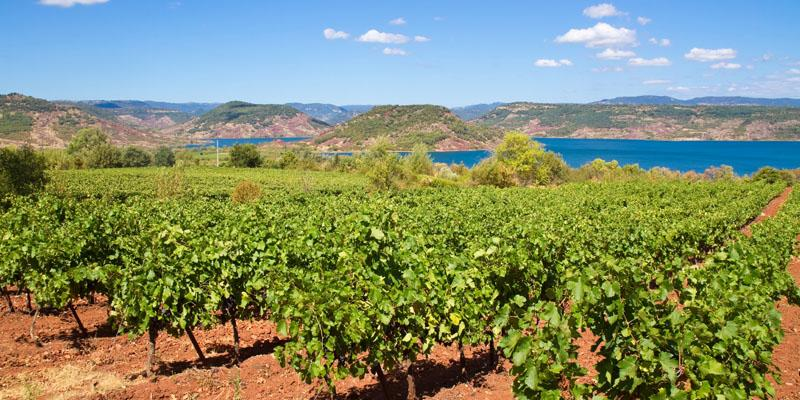
I think that’s the useful lens for approaching Languedoc-Roussillon: less a single coherent region with a settled identity, more a sprawling patchwork where reputation is still being actively written, appellation by appellation, producer by producer. You won’t find the tidy hierarchies of Burgundy here, or a single unifying story the way Bordeaux has its Left Bank and Right Bank. What you’ll find instead is old-vine Carignan pulled back from the brink of irrelevance, biodynamic pioneers working schist hillsides that cooperatives had written off decades ago, and a genuinely wild stretch of Roussillon coastline making fortified sweet wine in a style that predates most of what’s considered classic French wine today.
This guide covers the region’s geography and its two halves, the grapes and appellations worth knowing, four estates spanning Languedoc’s interior and Roussillon’s coast, and an honest read on where to actually find these wines at Dutch and Spanish retailers, since this is one of the patchier categories in this entire series when it comes to mainstream availability.
Two Regions Sharing One Coastline
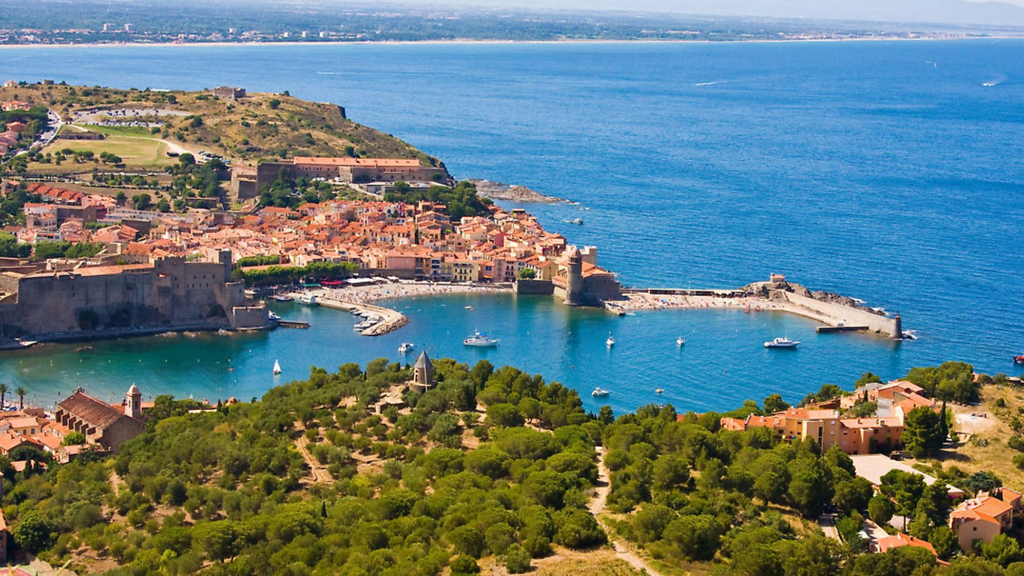
Languedoc and Roussillon get lumped together so often that it’s easy to forget they’re historically and culturally distinct places that happen to share a border and a Mediterranean climate. Languedoc, the larger of the two, stretches roughly from Nîmes in the east to Narbonne in the west, a huge sweep of land divided informally into the Aude department around Carcassonne (home to Corbières, Minervois, and Fitou) and the Hérault department around Montpellier (home to Faugères, Saint-Chinian, Pic Saint-Loup, and Picpoul de Pinet, among others). Roussillon, smaller and more geographically contained, sits further south still, wedged against the Pyrenees and the Spanish border, historically Catalan in language and culture before it was French, a fact that shows up everywhere from village names to the food.
Geologically, this is one of the most varied stretches of vineyard land in France, and that variety is a genuine selling point rather than a footnote. Schist dominates around Faugères and much of coastal Roussillon, giving wines a certain smoky, mineral edge. Limestone and clay run through Corbières and parts of Minervois. Sandy, alluvial soils near the coast produce something altogether softer. And in Roussillon specifically, the vineyards form what’s sometimes described as a natural amphitheater, ringed by three mountain massifs and cut through by three rivers, the Agly, Têt, and Tech, each carving its own distinct microclimate as it runs down toward the sea.
Climate throughout is reliably Mediterranean: hot, dry summers, mild winters, and enough sunshine that ripening is rarely the concern it is further north. The real defining feature, though, is wind. The Tramontane, a fierce, dry wind that funnels down from the Pyrenees and the Massif Central, keeps humidity and disease pressure low, which is a large part of why organic and biodynamic farming has taken off here more easily than in wetter regions. It also makes for genuinely windswept, characterful vineyards, with some of the old bush vines here trained low and gnarled specifically to survive it.
How a Bulk-Wine Region Became a Quality Story
To understand where Languedoc-Roussillon is now, you have to understand how far it fell, and that’s not really an exaggeration. The Romans planted here first, before Bordeaux or Burgundy existed as wine regions at all, and by the Middle Ages Languedoc had a genuinely serious reputation, Saint-Chinian’s reds in particular. Things stayed reasonably strong through centuries of upheaval, including the brutal Albigensian Crusade of the early 13th century, which reshaped the region’s politics without destroying its winemaking.
The real turning point, for better and then for considerably worse, was the 19th century. The Canal du Midi, completed in 1681, had already opened trade routes toward the Atlantic; the railway’s arrival in 1853 blew the doors wide open, connecting the Languedoc directly to Paris and enabling wine to be shipped north in volumes that simply hadn’t been possible before. Growers responded exactly how you’d expect: by planting for yield rather than quality, favoring high-cropping varieties that could fill barrels quickly for a thirsty national market. Phylloxera arrived not long after and, ironically, made this worse rather than better, since replanting on resistant rootstock became another opportunity to favor productivity over character.
By the mid-20th century, the region had settled into a role as France’s bulk-wine engine, dominated by cooperatives churning out enormous quantities of undistinguished red, much of it destined for blending or for the everyday French table. The EU’s infamous “wine lake” subsidies of the 1970s and 80s, essentially paying growers to distill or dump surplus production, were largely a Languedoc-Roussillon problem, and for a long time, that reputation was the only one this region had internationally.
The revival, when it came, was driven by outsiders and mavericks as much as by anyone with local roots. Aimé Guibert, a former glove manufacturer with no winemaking background, bought land in the Gassac valley in the early 1970s on the recommendation of a Bordeaux geology professor who took one look at the terroir and declared it unusually suited to serious wine. His estate, and I’ll get to it properly below, became the region’s proof of concept, the wine that made critics and journalists sit up and take Languedoc seriously for the first time in living memory. Others followed through the 1980s and 90s: young winemakers priced out of Burgundy or Bordeaux, drawn south by cheap land, old neglected vines, and a genuine sense of open frontier. That wave hasn’t really stopped; it’s just gotten more sophisticated, more organic and biodynamic, and considerably better documented by critics who now treat the region as a legitimate source of serious wine rather than a curiosity.
Grapes: A Mediterranean Palette
Languedoc-Roussillon’s grape variety list runs longer than almost anywhere else in France, a direct legacy of its Mediterranean position and its long history of trade and migration across the region.
Carignan is the grape most associated with the region’s old-vine revival. Once dismissed as a rustic, over-tannic workhorse suited only to bulk blending, old Carignan vines, some over a century old, are now prized by quality-focused producers for the concentration and character low yields bring out, particularly in Corbières and Minervois.
Grenache, Syrah, and Mourvèdre, the same trio that anchors the Southern Rhône, do much of the region’s heavy lifting for red and rosé blends, often alongside Carignan and Cinsault in varying proportions depending on the appellation and producer’s preference.
Picpoul, a crisp, citrusy white grape, has its own dedicated appellation in Picpoul de Pinet near the coast, an increasingly popular, food-friendly white that’s become something of a gateway wine for readers newly discovering the region.
Grenache Blanc, Roussanne, Marsanne, Bourboulenc, and Vermentino (locally called Rolle) round out the white and rosé side, particularly in the more ambitious appellations like La Clape and Terrasses du Larzac.
Muscat, in Roussillon especially, underpins a genuinely distinctive local specialty: vin doux naturel, fortified sweet wine made by arresting fermentation with added spirit, a tradition dating back to the 13th century and a technique credited to Arnaud de Villeneuve, a physician working at the University of Montpellier. Banyuls and Maury, Roussillon’s two most celebrated fortified appellations, are built on Grenache rather than Muscat, while Muscat de Rivesaltes carries that grape’s name directly.
Appellations Worth Knowing
Languedoc-Roussillon doesn’t have anything resembling Burgundy’s clean four-tier hierarchy or Bordeaux’s estate classifications. What it has instead is a genuinely large, still-evolving list of AOCs, some well established, some quite recently carved out of the broader regional Languedoc AOC as producers in specific areas push for recognition of their own terroir.
The broad Languedoc AOC (which replaced the older Coteaux du Languedoc designation in 2007) covers most of the region and produces the bulk of everyday drinking wine, alongside increasingly ambitious bottlings from producers who choose to work within it rather than a narrower sub-appellation. Beneath and alongside it sit the named appellations that most wine drinkers will actually encounter on a label: Minervois, one of the largest and most established, known for robust Syrah-Carignan-Grenache reds, with its own elevated sub-zone, Minervois-La-Livinière, recognized separately in 1999 for its particularly age-worthy wines. Corbières, Languedoc’s largest appellation by area, is rugged and varied, earthy and savory in character, with its own respected sub-zone in Corbières-Boutenac built around old-vine Carignan. Fitou, carved out in two separate pockets within Corbières, holds the distinction of being Languedoc’s very first AOC, established in 1948. Faugères and Saint-Chinian, both schist-dominated and centered northwest of Béziers, are widely considered among the region’s most serious red-wine appellations. And a newer generation of terroir-specific zones, Pic Saint-Loup, Terrasses du Larzac, La Clape, and others, have gained AOC recognition only in the last couple of decades, reflecting the region’s ongoing project of subdividing itself into more precisely defined, higher-quality parcels, not unlike watching an appellation system get built in real time rather than inheriting one already finished.
Roussillon runs its own separate set of appellations: Côtes du Roussillon and Côtes du Roussillon Villages for dry reds, Collioure for the dry wine counterpart to Banyuls (often made by the same producers from the same steep coastal vineyards), and the fortified vin doux naturel appellations, Banyuls, Banyuls Grand Cru, Maury, Rivesaltes, and Muscat de Rivesaltes, which remain the region’s most historically distinctive and, arguably, most underrated wines.
Four Estates Worth Visiting
These four span the region’s range and its geography: the estate that essentially launched Languedoc’s quality reputation, a biodynamic pioneer in Roussillon’s interior, a large, ambitious Corbières property blending wine tourism with genuine quality farming, and a family estate on the Banyuls coast making both dry and fortified wine from the same steep vines.
Mas de Daumas Gassac (Aniane, Languedoc)
If there’s one estate responsible for the world taking Languedoc seriously at all, it’s this one. Aimé and Véronique Guibert planted their first vines here in 1974 in the Gassac valley near Aniane, on land whose unusual terroir, a cool microclimate shaped by the Gassac river and surrounding mountains, was singled out by Bordeaux geology professor Henri Enjalbert as uncharacteristically well suited to serious wine in a warm region. The wine that resulted, a Cabernet-led blend of grapes drawn from across the world’s great vineyards rather than the region’s traditional varieties, was declared “a grand cru of the Languedoc” by a French journalist in 1981 and has carried that reputation, sometimes a little uneasily, ever since. Now run by the Guibert family’s four sons, the estate remains classified only as IGP rather than AOC, since its grape mix sits outside appellation rules, a technicality that’s never dented its standing.
- Address: Haute Vallée du Gassac, 34150 Aniane, France
- Contact: +33 (0)4 67 57 71 28, contact@daumas-gassac.com
- Visiting: Open Monday to Saturday, 10:00 to 12:00 and 14:00 to 18:00 (non-stop 9:30 to 18:30 in July and August), closed Sundays and public holidays. Cellar tours and tastings by appointment, bookable online through the estate’s website; groups of more than eight should contact the estate directly.
Domaine Gauby (Calce, Roussillon)
Gérard Gauby took over his family’s estate in the village of Calce, in the hills northwest of Perpignan, in 1985, and spent the following decades pulling it away from bulk production toward something far more exacting: organic farming from the 1990s, full biodynamic conversion from 2001, and a fanatical focus on old vines and minimal intervention that made the domaine a reference point for the entire natural wine movement in the south of France, not just Roussillon specifically. Now joined by his son Lionel and daughter-in-law Lucie, the estate farms around 45 hectares across a genuinely dramatic range of soils, schist, limestone, and granite among them, producing wines that regularly get compared to serious Burgundy for their precision, a comparison that would have sounded absurd applied to this corner of France a generation ago.
- Address: 1 La Fontane, 66600 Calce, France
- Contact: +33 (0)4 68 64 35 19, domaine.gauby@wanadoo.fr
- Visiting: By appointment only; the estate does not accept walk-ins or card payment on site, so contact ahead and plan to bring cash if buying directly. Reception and tasting typically take place at the estate’s village address rather than the outlying vineyard plots.
Château de Lastours (Portel-des-Corbières, Languedoc)
Sprawling across more than 800 hectares of garrigue at the entrance to the Corbières massif, with just 100 hectares actually under vine, Château de Lastours has a history stretching back to the 19th century, when the Calas and then Martin families, both keen botanists, first built its reputation. The Allard family, who bought the estate in 2004, have invested heavily in both wine quality and wine tourism since, achieving organic certification across the vineyard in 2020 and building out one of the more architecturally striking modern winemaking facilities in the Languedoc. What makes a visit here genuinely different from most of the estates in this series is the sheer scale of what surrounds the vines: 85 kilometers of trails once used for the Dakar Rally, now open for mountain biking and 4×4 excursions, alongside a restaurant and on-site accommodation, meaning a Lastours visit can easily stretch from an afternoon tasting into a full day or overnight stay.
- Address: Château de Lastours, 11490 Portel-des-Corbières, France
- Contact: +33 (0)4 68 48 64 74, contact@chateaudelastours.com
- Visiting: Open year-round with fixed-time guided tours by appointment, Monday to Saturday 10:00 to 19:00, Sunday 14:00 to 19:00. The on-site restaurant, La Bergerie, requires a separate reservation at +33 (0)4 68 48 73 40.
Domaine de la Rectorie (Banyuls-sur-Mer, Roussillon)
Run by the Parcé family, whose roots in Banyuls trace back generations, Domaine de la Rectorie farms around 30 hectares spread across roughly 30 individual parcels on the steep, terraced hillsides that drop almost directly into the Mediterranean, vineyards worked essentially by hand given the terrain’s refusal to accommodate much machinery. Thierry Parcé, who has vinified here since 1984 and trained the current generation under him, produces both dry Collioure and fortified Banyuls from the same Grenache-heavy vines, a genuinely useful single-estate way to taste the difference fortification makes when everything else about the grape and site stays constant. The domaine’s underground cellar, carved into the hillside, adds a proper sense of place to what’s already one of the more visually dramatic wine landscapes in France.
- Address: 65 Avenue du Puig del Mas, 66650 Banyuls-sur-Mer, France
- Contact: +33 (0)4 68 88 13 45, info@rectorie.fr
- Visiting: Open Tuesday to Saturday, roughly 10:00 to 12:30 and 15:00 to 18:30 (Monday afternoons only), closed Sundays. A dedicated cellar tour and tasting through the estate’s underground cave, priced around €25 per person, runs Tuesday to Friday by reservation; contact the estate directly to book.
Where to Buy Languedoc-Roussillon Wine
I want to be straightforward about this section, because Languedoc-Roussillon is genuinely the least consistently stocked region covered anywhere in this series so far, at least when it comes to the four specific estates profiled above.
None of Mas de Daumas Gassac, Domaine Gauby, Château de Lastours, or Domaine de la Rectorie were confirmed in current stock at Wijnbeurs, Colaris, or Decántalo at the time of writing. This isn’t unusual for the region as a whole; Decántalo does carry a general Languedoc-Roussillon selection, including wines under the Côtes du Roussillon, Faugères, La Clape, and Minervois-La-Livinière designations, but not from these specific four producers. Mas de Daumas Gassac in particular is sold largely on an allocation basis internationally, and readers wanting it are more likely to find success through the estate’s own online shop or through specialist importers who carry small volumes each vintage. Domaine Gauby, similarly allocation-driven given its cult status among natural wine specialists, tends to appear at dedicated natural and biodynamic wine shops rather than general retailers.
Also, Wijnbeurs tends to have a smaller selection of Languedoc wines available at a very good price point. Especially their Domaine Clos Charlotte Cabardès is very well rated.
For Château de Lastours and Domaine de la Rectorie, both estates sell directly through their own webshops, and Lastours in particular, given its larger production volume, is a reasonable candidate to check periodically at Colaris and Wijnbeurs even though it wasn’t confirmed at the time of research, since regional selections at both retailers do rotate. WirWinzer and Drinks & Co remain worth checking for the fortified Roussillon wines specifically, since Banyuls and Maury tend to have slightly broader specialist distribution than the region’s dry wines.
If there’s a silver lining here, it’s that Languedoc-Roussillon rewards exactly the kind of direct-to-estate buying that feels increasingly natural for wine, given how many of its most interesting producers are small, family-run, and genuinely happy to ship a case to an interested buyer abroad.
Food Pairing
The Languedoc’s Mediterranean, herb-driven cuisine and its wine developed side by side, and the pairings here feel less like a formal exercise than an obvious extension of how people actually eat along this coast. Robust Corbières and Minervois reds, built on Carignan, Syrah, and Grenache, pair naturally with cassoulet, grilled lamb rubbed with garlic and rosemary, or a rich daube, the kind of slow-cooked, herb-heavy dishes that define southern French cooking. Faugères and Saint-Chinian’s schist-driven reds, with their savory, slightly smoky edge, suit grilled meats and game particularly well.
Picpoul de Pinet, crisp and citrusy, is the textbook match for the oysters farmed in the nearby Étang de Thau lagoon, a pairing so local and so reliable it’s practically the region’s calling card. Roussillon’s dry Collioure whites and rosés work well with the area’s own anchovy-and-seafood-forward cooking, a genuine nod to the region’s Catalan roots.
Banyuls and Maury, the fortified sweet wines, deserve a wider audience than they generally get. Banyuls in particular is a genuinely superb match for dark chocolate desserts, a pairing French sommeliers have known about for a long time and one that consistently surprises people encountering it for the first time. Both also pair beautifully with blue cheese, and with the region’s own Roquefort in particular, the sweetness and the salt do exactly what good contrast is supposed to do.
Getting There and Planning Your Trip
Montpellier, with its own airport and direct TGV connections, is the natural gateway for the Languedoc side of the region, sitting close to Faugères, Pic Saint-Loup, and Mas de Daumas Gassac in Aniane, roughly 30 minutes away. Narbonne and Carcassonne, both accessible by train, work better as bases for Corbières and Minervois, with Carcassonne’s well-preserved medieval citadel worth a half day in its own right before heading into the vineyards. Perpignan, further south, is the sensible base for Roussillon, sitting close to Calce and within reasonable driving distance of the Banyuls and Collioure coastline, roughly 45 minutes south.
Given how spread out the region genuinely is, more so than almost anywhere else covered in this series, a car is close to essential if you’re trying to cover more than one sub-region in a single trip. Treating Languedoc’s interior and Roussillon’s coast as two separate legs, rather than attempting both in a few rushed days, tends to make for a considerably more relaxed visit, and it mirrors how distinct the two areas feel on the ground despite sharing a regional name.
Harvest generally runs from late August through September, on the earlier side compared to regions further north, a function of the reliably warm Mediterranean climate. The Tramontane wind can pick up unpredictably at any time of year and is worth factoring into outdoor plans, particularly around the exposed Roussillon coastline. Spring and early autumn offer the most comfortable weather for vineyard visits, while summer brings the coastal towns, Collioure especially, a level of tourist traffic that’s worth planning around if quiet, unhurried winery visits are the priority.
Frequently Asked Questions
Why was Languedoc-Roussillon historically known for cheap wine? The completion of the railway in 1853 connected the region directly to Paris and the rest of France, and growers responded by planting high-yield varieties suited to bulk production rather than quality. That approach dominated for well over a century, cementing the region’s reputation as a source of everyday table wine rather than serious wine, a reputation that’s only meaningfully shifted in the last few decades.
What’s the difference between Languedoc and Roussillon? Languedoc is the larger, eastern portion of the combined region, historically part of the broader Occitan cultural area, while Roussillon, smaller and further south against the Spanish border, has a distinct Catalan history and identity. The two are administratively and commercially grouped together, but their grape varieties, appellations, and cultural character genuinely differ.
What is vin doux naturel? Vin doux naturel is a fortified sweet wine style specific to Roussillon, made by adding spirit partway through fermentation to halt the process and preserve natural grape sugar. Banyuls and Maury are the two most celebrated examples, both built primarily on Grenache, and the technique dates back to the 13th century.
Is Languedoc-Roussillon wine good value? Generally, yes, particularly relative to more established French regions, since the area’s quality reputation is still catching up to what serious producers are actually achieving in the bottle. That said, cult estates like Mas de Daumas Gassac and Domaine Gauby now command prices that reflect their reputation rather than the region’s historically low profile, so value varies considerably by producer.