Syrah, Grenache & the Rhône Valley’s Two Wine Worlds
Few French wine regions ask a traveler to hold two genuinely different ideas in their head at once quite like the Rhône. Drive from Ampuis to Avignon, and you pass through what amounts to two separate wine countries sharing a single river and a single name. The north is narrow, steep, and almost monastic in its devotion to a single red grape on granite hillsides so severe that vineyard work still happens by hand and, in places, by winch. The south opens into broad, sun-baked plains where a dozen or more grape varieties can legally end up in the same bottle, and where the defining sensation isn’t steepness but heat, wind, and the crunch of round river stones underfoot.
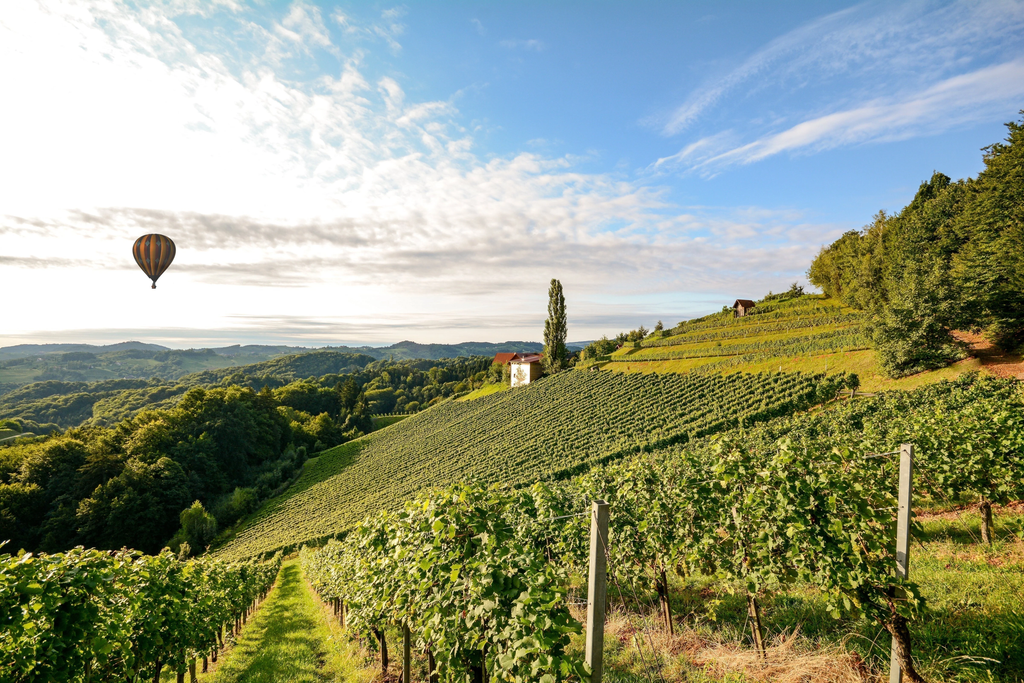
This is genuinely useful to understand before buying a bottle labeled simply “Côtes du Rhône,” since that single appellation name covers wine from two regions with almost nothing in common beyond geography and a shared river. The Rhône rewards a reader willing to learn the difference between Côte-Rôtie and Châteauneuf-du-Pape not as trivia but as the key to predicting what’s actually in the glass, whether that’s a linear, peppery, single-varietal Syrah or a warm, generous, multi-grape blend built for a completely different table.
This guide covers the Northern and Southern Rhône separately, the region’s grapes and classification structure, four estates spanning Condrieu, Hermitage, Châteauneuf-du-Pape, and Gigondas, and where to find these wines at Dutch and Spanish retailers.
Two Regions, One River
The Rhône Valley runs roughly 200 kilometers from Vienne, just south of Lyon, down to Avignon, following the river toward the Mediterranean, and it is the second-largest wine region in France by volume after Bordeaux. But production volume tells only part of the story, since the Northern and Southern Rhône operate on entirely different logics.
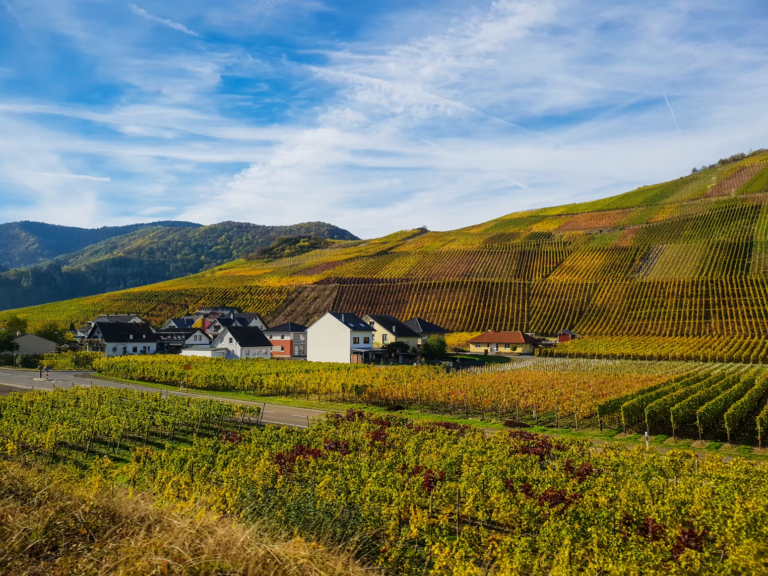
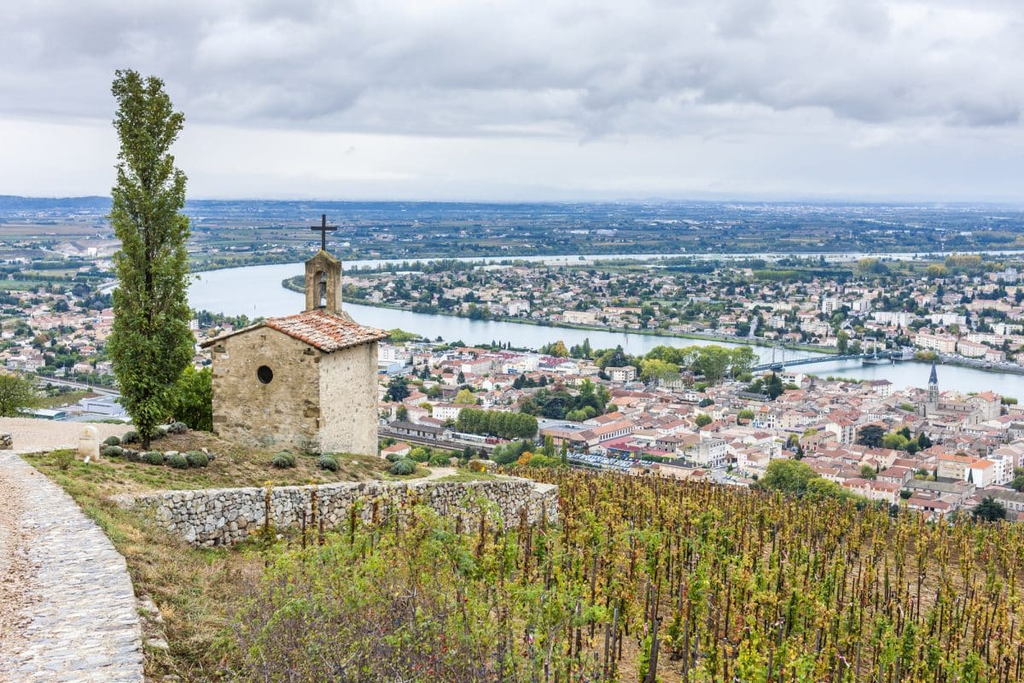
The Northern Rhône, stretching about 65 kilometers from Vienne to Valence, is narrow and dramatic, its vineyards planted on impossibly steep granite and schist slopes rising directly from the riverbank, some pitched at inclines that make mechanization impossible even today. This is Syrah’s ancestral home and, in nearly every Northern Rhône red appellation, the only permitted red grape. The climate here is semi-continental with only a hint of Mediterranean influence, cooler and more marginal than the south, which shows in the wine’s structure: firm, peppery, often quite savory in youth, built to soften over years rather than immediately generous.
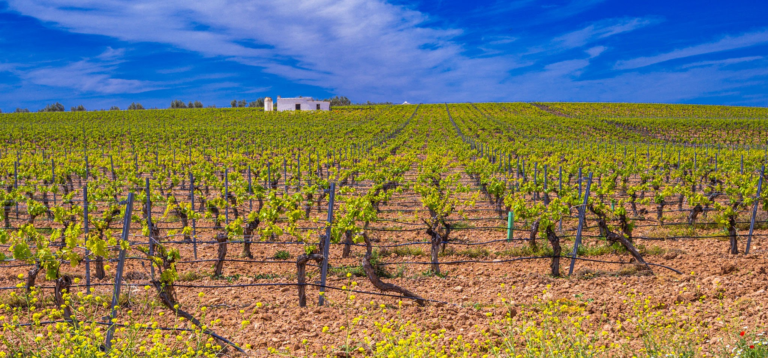
The Southern Rhône, beginning around Montélimar and stretching down past Avignon, is an entirely different landscape: broad, sun-drenched, and Mediterranean in climate, with vineyards spread across a much larger area and a far more varied set of soils, from the famous rolled river stones (galets roulés) of Châteauneuf-du-Pape to clay, sand, and limestone elsewhere. Grenache dominates here, typically blended with Syrah, Mourvèdre, and a long tail of other permitted varieties, producing wine that leans warm, generous, and often higher in alcohol than its northern counterparts. The Mistral, the powerful wind that funnels down the valley, plays a genuine viticultural role here too, keeping vineyards dry and disease pressure low even in a hot climate.
Between the two, roughly between Valence and Montélimar, lies a stretch of river with comparatively little vineyard land at all, a geographic gap that reinforces just how distinct these two halves of the Rhône really are, more like neighboring regions that happen to share a name than a single continuous wine country.
A Short History
The Rhône’s winemaking pedigree is among the oldest in France, with the Romans planting vines along the river as a natural extension of trade routes running north from the Mediterranean, and Hermitage in particular carries a documented reputation stretching back centuries, once ranked among the most prized wines in Europe, commanding prices that in some periods rivaled or exceeded those of top Bordeaux.
The Southern Rhône’s defining institutional moment came earlier than almost anywhere else in France. In the 14th century, the Avignon Papacy, when the seat of the Catholic Church relocated from Rome to Avignon under a succession of French popes, established a summer residence at what’s now Châteauneuf-du-Pape, literally “the Pope’s new castle,” and planted vineyards to supply the papal court. That papal association gave the area an early reputation and a name that still defines the appellation today.
Châteauneuf-du-Pape holds another, quieter distinction: it became the first appellation in France to establish formal production rules, under Baron Pierre Le Roy de Boiseaumarié in 1923, a full decade before the national INAO system was formalized in 1935. Le Roy’s local rules, covering permitted grape varieties, minimum alcohol levels, and vineyard practices, effectively became the template the rest of France’s AOC system was built on, making this sun-baked corner of the Southern Rhône an unlikely but genuine birthplace of modern French wine law.
The Northern Rhône, meanwhile, endured a harder 20th century. Phylloxera and the difficulty of farming its steep slopes by hand, combined with rural depopulation, left appellations like Côte-Rôtie reduced to a small fraction of their historical vineyard area by the mid-20th century. The region’s revival from the 1970s onward, driven by a handful of ambitious growers willing to replant the most difficult sites, is a large part of why Northern Rhône wine now commands the reputation and prices it does today.
Grapes: A Tale of Two Philosophies
The Rhône’s two halves approach grape variety almost as differently as they approach everything else.
Syrah is the Northern Rhône’s defining, often sole, red grape, producing deeply colored, structured wines with characteristic black pepper, olive, and violet notes, capable of real aging in top sites like Côte-Rôtie, Hermitage, and Cornas.
Viognier, though planted in far smaller quantities, gives the Northern Rhône its most distinctive white wine in Condrieu, intensely aromatic with notes of apricot, peach, and honeysuckle, grown almost entirely on the steep granite terraces around the village that shares its appellation’s name. Notably, a small percentage of Viognier is traditionally permitted to be co-fermented with Syrah in Côte-Rôtie, a practice that softens and perfumes the red wine in a way unique to that appellation.
Marsanne and Roussanne, the Northern Rhône’s other white grapes, appear in Hermitage Blanc, Crozes-Hermitage, and Saint-Péray, producing fuller-bodied, often nutty white wines with real aging potential, a genuine curiosity for readers who assume all serious white Rhône wine is Viognier.
Grenache is the Southern Rhône’s backbone, contributing generosity, warmth, and body, almost always blended rather than bottled alone, most famously alongside Syrah and Mourvèdre in what’s commonly shorthanded as a GSM blend, though Southern Rhône appellations, Châteauneuf-du-Pape most extravagantly, can legally include far more varieties than that abbreviation suggests. Châteauneuf-du-Pape permits 13 varieties in total, including lesser-known reds like Cinsault and Counoise, and whites such as Clairette, Grenache Blanc, and Bourboulenc, all of which can technically appear in the same blend, even though most producers lean heavily on Grenache, Syrah, and Mourvèdre in practice.
Classification: Côtes du Rhône, Villages & the Crus
The Rhône’s classification system runs across three tiers, applied somewhat differently in the north and south given how differently the two halves are structured.
Côtes du Rhône, the base appellation, covers the broadest geographic area and accounts for roughly 60% of total regional production, spanning both the north and south, though the overwhelming majority of Côtes du Rhône wine actually comes from Southern Rhône vineyards given the north’s much smaller total footprint.
Côtes du Rhône Villages sits above the base tier, covering a smaller number of communes, some entitled to add their own village name to the label (such as Cairanne or Séguret), producing wine of generally higher concentration and quality than base Côtes du Rhône.
The Crus represent the top tier, standalone appellations that drop the Côtes du Rhône name entirely, printing only their own name on the label, a structural echo of how Beaujolais crus work. There are 17 crus in total, split between north and south. The Northern Rhône’s crus, Côte-Rôtie, Condrieu, Château-Grillet (France’s smallest appellation, a single estate under 4 hectares), Saint-Joseph, Cornas, Hermitage, Crozes-Hermitage, and Saint-Péray, are individually delimited, site-specific appellations. The Southern Rhône’s crus, led by Châteauneuf-du-Pape but also including Gigondas, Vacqueyras, Rasteau, Lirac, Tavel (dedicated entirely to rosé), Vinsobres, Beaumes-de-Venise, Cairanne, and others, tend to cover a wider area at village or multi-village scale rather than individual vineyard plots.
Within Châteauneuf-du-Pape specifically, the appellation caps yields lower than standard Côtes du Rhône and requires a minimum alcohol level of 12.5%, among the highest baseline requirements in France, a rule dating back to Le Roy’s original 1923 regulations and reflecting the area’s naturally high ripeness levels.
Four Rhône Estates Worth Visiting
These four estates span the region’s full range: Viognier in the Northern Rhône’s Condrieu, historic Syrah on the Hermitage hill, the birthplace of Châteauneuf-du-Pape’s own appellation rules, and Grenache-driven Gigondas in the shadow of the Dentelles de Montmirail.
Domaine Georges Vernay (Condrieu, Northern Rhône)
Founded by Georges Vernay, who earned the nickname “the Pope of Condrieu” for his role in single-handedly keeping the appellation alive when it had shrunk to just a handful of hectares in the mid-20th century, this estate is now run by his daughter Christine, who took over in 1997 and has continued the family’s meticulous, terroir-focused approach. The domaine farms across 16 hectares split between Condrieu, Côte-Rôtie, and Saint-Joseph, all organically certified, and its Coteau de Vernon parcel holds some of the oldest Viognier vines in the entire appellation, planted by Georges’ father Francis at the AOC’s creation in 1940.
- Address: 1 Rue Nationale, 69420 Condrieu, France
- Contact: +33 4 74 56 81 81, contact@georges-vernay.fr
- Visiting: By appointment; contact the estate ahead of a planned visit through domainevernay.com. The shop and tasting space are located directly at the domaine in the village of Condrieu.
Paul Jaboulet Aîné (Tain-l’Hermitage, Northern Rhône)
Founded in 1834 and now owned and run by the Frey family, with winemaking direction from Caroline Frey since 2006, Paul Jaboulet Aîné is one of the Northern Rhône’s largest and most historically significant estates, holding roughly 22 hectares on the Hermitage hill alone among more than 100 hectares total spanning Hermitage, Crozes-Hermitage, Cornas, Saint-Péray, and Condrieu. Its flagship Hermitage La Chapelle, named for the small chapel still standing at the top of the hill, has been considered a benchmark for the appellation for generations. The estate has farmed organically since 2016 and biodynamically across an increasing share of its vineyards, and unlike many of the region’s smaller, appointment-only domaines, operates The Vineum, a dedicated tasting room, wine bar, and restaurant in the town of Tain-l’Hermitage, genuinely built for visitors.
- Address: The Vineum, 25 Place du Taurobole, 26600 Tain-l’Hermitage, France
- Contact: +33 4 75 84 68 93
- Visiting: The Vineum is open to the public with tastings, themed vineyard-and-tasting experiences, and a restaurant; booking ahead is recommended, particularly for guided tours up the Hermitage hill itself. Group size is generally capped for the more in-depth experiences.
Château de Beaucastel (Châteauneuf-du-Pape, Southern Rhône)
Run by the Perrin family since 1909 and now overseen by the fifth generation, Château de Beaucastel farms 100 hectares in a single block at the northern edge of the Châteauneuf-du-Pape appellation, organically certified since the 1950s, decades ahead of most of the wine world, and biodynamic since the 1970s. Beaucastel is distinctive even within Châteauneuf-du-Pape for using all 13 permitted grape varieties in its red blend and for an unusually high proportion of Mourvèdre relative to most estates in the appellation, giving its wine real structure and aging potential. Its Hommage à Jacques Perrin, made only in strong vintages from the estate’s oldest Mourvèdre and Grenache vines, is among the most sought-after wines in the entire Southern Rhône.
- Address: Chemin de Beaucastel, 84350 Courthézon, France
- Contact: +33 4 90 70 41 00, contact@beaucastel.com
- Visiting: Estate visits are by appointment only, Monday to Friday, roughly 9:30 to 17:00 with reduced Friday afternoon hours; book well ahead through beaucastel.com. Visitors without a confirmed estate appointment can still taste the Perrin family’s wines, including several Beaucastel bottlings, at La Cave Famille Perrin, the family’s walk-in tasting room in the village of Châteauneuf-du-Pape itself.
Château Saint-Cosme (Gigondas, Southern Rhône)
Owned by the Barruol family since the 15th century and now run by Louis Barruol, who took over in 1992, Château Saint-Cosme is among the oldest continuously worked estates in the entire Southern Rhône, with archaeological evidence of Gallo-Roman winemaking on the property, including rock-cut fermentation vats still visible in the cellar today. Its 22 hectares of vines, averaging 60 years old, are farmed organically on the limestone-influenced slopes beneath the Dentelles de Montmirail, the jagged limestone ridge that gives Gigondas its dramatic backdrop, and Barruol has become one of the appellation’s most respected and quality-focused voices, alongside a smaller Côte-Rôtie négociant operation under the same name.
- Address: 126 Route des Dentelles, 84190 Gigondas, France
- Contact: +33 4 90 65 80 80, barruol@chateau-st-cosme.com
- Visiting: Open Monday to Friday, 9:00 to 17:30, with tastings in the estate’s historic Roman and 18th-century cellar buildings; contact ahead for a guided visit, particularly outside standard opening hours.
Where to Buy Rhône Wine
The Rhône is genuinely well distributed across the three preferred retailers for this series, reflecting both the region’s overall production volume and its established reputation across European markets.
Decántalo carries all four estates profiled here. Domaine Georges Vernay appears across its Condrieu, Côte-Rôtie, and Saint-Joseph bottlings, including the flagship Les Terrasses de l’Empire Condrieu. Paul Jaboulet Aîné’s Hermitage La Chapelle and Crozes-Hermitage Les Jalets are both available, and Château de Beaucastel is stocked in real depth, including the standard Châteauneuf-du-Pape Rouge and, notably, the rare Hommage à Jacques Perrin cuvée, not always easy to find at general retailers given its limited production.
Colaris also carries Château Saint-Cosme’s Condrieu bottling directly, alongside a broader Rhône selection worth checking given the retailer’s stated focus on Bordeaux-adjacent categories over the years; Saint-Cosme’s Gigondas itself is worth confirming directly with the retailer given how quickly small-production cuvées can sell through.
For on a smaller budget, Wijnbeurs offers a very decent Côtes du Rhône Domaine de la Bastide.
For rarer, more allocation-driven Northern Rhône producers not covered in the four estate profiles here, particularly single-grower Côte-Rôtie and Cornas from smaller domaines, WirWinzer and specialist Rhône-focused importers remain useful fallbacks, since Northern Rhône production volumes are considerably smaller than the Southern Rhône’s and allocations can be tight even at well-stocked retailers.
Food Pairing
The Rhône’s north-south divide carries through naturally to the table. Northern Rhône Syrah, with its firm structure and peppery, savory character, pairs well with grilled or roasted red meat, particularly lamb, and with game dishes in autumn and winter, its acidity and tannin cutting cleanly through richer fare. Condrieu’s Viognier, aromatic and full-bodied despite being a dry white, suits richer fish preparations, particularly anything with a cream or butter-based sauce, as well as soft cheeses.
Southern Rhône reds, warmer and more generous, are the natural match for the region’s own Provençal-leaning cuisine: daube (slow-braised beef stew), grilled lamb with herbes de Provence, or a hearty cassoulet-adjacent dish, standing up to the Mediterranean’s characteristic use of garlic, olive oil, and thyme. Châteauneuf-du-Pape in particular, with its structure and warmth, pairs well with roasted duck or a well-aged hard cheese. Tavel and other Southern Rhône rosés, drier and more structured than many rosés elsewhere in France, hold their own against grilled vegetables, charcuterie, or a simple bouillabaisse.
Getting There and Planning Your Trip
Lyon serves as the natural gateway for the Northern Rhône, with Lyon–Saint-Exupéry Airport connecting well to Amsterdam and other European hubs, and the city itself sitting under an hour from Vienne and Condrieu, the Northern Rhône’s northernmost vineyards. Avignon, further south, is the more practical base for the Southern Rhône, reachable by direct TGV from Paris in under three hours and sitting close to Châteauneuf-du-Pape, Gigondas, and the broader Vaucluse wine country.
A car is genuinely necessary for both halves of the region, though for different reasons. In the Northern Rhône, appellations cluster tightly along a narrow corridor, but individual domaines sit on steep, often narrow roads without meaningful public transport; in the Southern Rhône, the appellations spread across a much wider area, making a car essential simply to cover the distance between, say, Châteauneuf-du-Pape and Gigondas, roughly 40 minutes apart. Given the geographic split, treating the Northern and Southern Rhône as two separate legs of a trip, rather than attempting both in the same few days, generally makes for a more relaxed and coherent visit.
Harvest in the Northern Rhône typically runs from mid-September, often later than the warmer south, where picking can begin as early as late August depending on the vintage. Spring and early autumn offer the most comfortable weather for visiting either half of the region, while summer, particularly July and August, brings both the Mistral’s cooling relief in the south and considerably higher tourist volume, making advance booking for winery visits genuinely important during that window.
Frequently Asked Questions
What’s the real difference between Northern and Southern Rhône wine? Northern Rhône reds are made almost exclusively from Syrah, grown on steep granite slopes in a cooler, semi-continental climate, producing structured, peppery wine. Southern Rhône reds are typically Grenache-based blends incorporating Syrah, Mourvèdre, and other varieties, grown in a warmer Mediterranean climate on flatter land, producing warmer, more generous wine. The two halves are geographically and stylistically distinct enough that “Rhône wine” as a single category is genuinely too broad to be useful.
Why can Châteauneuf-du-Pape contain 13 grape varieties when most French appellations use far fewer? The appellation’s founding rules, established in 1923 by Baron Le Roy, deliberately permitted a wide range of traditional local varieties rather than restricting the blend narrowly, reflecting how the area had historically been planted. Most producers still lean heavily on Grenache, Syrah, and Mourvèdre in practice, but the rules allow considerably more flexibility than that shorthand suggests.
Is all Côtes du Rhône the same quality level? No. Côtes du Rhône is the base appellation covering the broadest area and largest volume, generally the simplest wines in the hierarchy. Côtes du Rhône Villages, and above that the 17 individual crus like Châteauneuf-du-Pape, Gigondas, and Hermitage, represent progressively smaller, more tightly regulated, and generally higher-quality tiers, similar in spirit to Beaujolais’ base-to-cru structure.
Can Northern Rhône red wine legally contain white grapes? Yes, in one specific case. Côte-Rôtie traditionally permits up to 20% Viognier to be co-fermented with Syrah, a practice that softens the red wine’s tannins and adds aromatic lift, though most producers today use a considerably smaller percentage, often just a few percent, for a more subtle effect.