Veneto Wine Region: Amarone, Soave & the Estates Worth Seeking Out
Most people arrive in the Veneto for Venice or Verona and leave without fully registering what they have driven through. Between those two cities alone, the landscape holds some of the most varied and genuinely important wine-producing territory in Italy. Limestone ridges rising north of Verona, volcanic basalt slopes east of the city, fog-shrouded plains giving way to Alpine foothills, and on every gradient, a grape variety with something specific to say about where it grew.
The Veneto produces more wine than any other Italian region by volume. That fact has, for decades, worked against its reputation. It conjures mass-market Pinot Grigio and watered-down Soave. What it should conjure is Amarone, one of the most technically unusual and intellectually serious red wines made anywhere in the world, alongside Soave Classico from ancient volcanic slopes, Valpolicella Ripasso with genuine depth, and Prosecco Superiore from a UNESCO-listed landscape of narrow terraced vineyards above Treviso.
This guide maps the region’s wine geography, explains what makes its key appellations distinctive, recommends four estates worth going out of your way to visit, and points to specific bottles you can source online right now through Wijnbeurs, Colaris, and Decantalo.
Understanding the Veneto’s Wine Geography
The Veneto stretches from the shores of Lake Garda in the west to the Venetian lagoon and the Adriatic coast in the east, bordered by the Dolomites to the north. This is a long and varied strip of territory, and the wine zones within it could not be more different from one another.
The most important wine-producing areas sit in a rough band running east from Lake Garda: first Bardolino and Lugana on the lake shores, then the hills of Valpolicella northwest of Verona, then Soave to the east of the city, and further northeast the Prosecco hills of Conegliano and Valdobbiadene. Between them lie extensive plains producing large volumes of everyday wine, but the quality story belongs to the hillside zones, where altitude, drainage, and distinctive soils do the work that makes a wine worth thinking about.
The Major Appellations
Valpolicella and Amarone: The Heart of Veneto’s Red Wine Story
Valpolicella sits in a series of parallel valleys running north from Verona toward the Lessini plateau. The Classico zone, historically the most respected, covers five communes: Fumane, Marano, Negrar, Sant’Ambrogio, and San Pietro in Cariano. The soils here are a mix of limestone, clay, and chalk, with drainage and altitude providing the natural stress that concentrates fruit and maintains acidity.
The grapes are Corvina Veronese, the dominant variety and the structural backbone of every wine in this appellation, supported by Corvinone (increasingly valued for its structure and dark fruit), Rondinella, and a handful of ancient local varieties including Oseleta and Molinara. Corvina is a late-ripening, thick-skinned variety with naturally high acidity and a signature aromatic profile of sour cherry, violet, and almond. Its thick skins make it especially suited to the appassimento process, the defining technique of Valpolicella’s most serious wines.
The appellation produces a spectrum of styles. At the entry level, Valpolicella Classico is a light, cherry-fruited red built for everyday drinking. The Superiore designation requires an additional year of ageing and more concentration. Ripasso, the most commercially successful wine in the range, is made by refermenting Valpolicella on the dried grape skins left over from Amarone production, extracting additional tannin, alcohol, and complexity. At the top of the pyramid sits Amarone della Valpolicella DOCG and the rare sweet Recioto della Valpolicella.
Amarone: What Appassimento Actually Means
Amarone is one of those wines that sounds complicated in theory and rewards patience in practice. The process that defines it, appassimento, involves laying harvested bunches of Corvina, Corvinone, and Rondinella on slatted bamboo racks or shallow crates in well-ventilated drying lofts called fruttai, where the grapes lose between 30 and 40 percent of their water content over 90 to 120 days. This concentrates sugars, acids, tannins, and aromatic compounds simultaneously.
When the dried grapes are pressed and fermented to complete dryness, the result is a wine of extraordinary density and alcohol, typically between 15 and 17 percent ABV. The legally required ageing is two years in oak before commercial release, four years for Riserva. In practice, serious producers give their Amarone considerably more time, and the wines often need a decade in the cellar before they begin to open.
Two broad styles have emerged in the modern era. The traditional school ages in large Slavonian oak casks (botti), producing wines of restrained fruit, dried herb, tobacco, and earth. The modern school leans toward small French barriques and tighter extraction, producing darker, more hedonistic wines with greater oak influence. The most compelling bottles find a balance between both, using a mix of vessel sizes and techniques to preserve Corvina’s natural perfume while building the structure needed for long ageing.
The Classico zone wines are generally considered the finest, but significant exceptions exist outside it. Romano Dal Forno, whose vineyards lie in the eastern Illasi valley, operates well outside the Classico zone but produces what many consider the most concentrated and complex Amarone made anywhere in the appellation.
Soave Classico: An Underrated White Worth Taking Seriously
Soave is one of the most misunderstood appellations in Italy. For decades, its name was associated with thin, vapid white wine produced in industrial quantities on the plains east of Verona. The reputation was not entirely undeserved; the DOC zone was expanded aggressively in the 1960s and 1970s to include flat, high-yielding vineyard land that bore no relationship to the historic hillside sites.
The Classico zone is different. Centred on the medieval town of Soave and its surrounding volcanic hills, it is dominated by basalt and tuff soils deposited by ancient lava flows, with pockets of limestone and calcareous clay. The primary grape is Garganega, a late-ripening white variety that, in these volcanic soils, expresses a mineral tension and textural richness completely at odds with the Soave of popular imagination. Trebbiano di Soave can make up a small percentage of the blend.
At the basic level, Soave Classico is approachable, almond-inflected, and citrus-fresh. Single-vineyard expressions from the best sites, La Rocca, Calvarino, and Vigneto du Lot, are wines of genuine structural complexity and ageing potential. The best bottles from producers like Pieropan, Gini, and Inama age over a decade without difficulty, developing honeyed richness and extraordinary mineral length.
Prosecco Superiore DOCG: The Other Side of Sparkling Wine
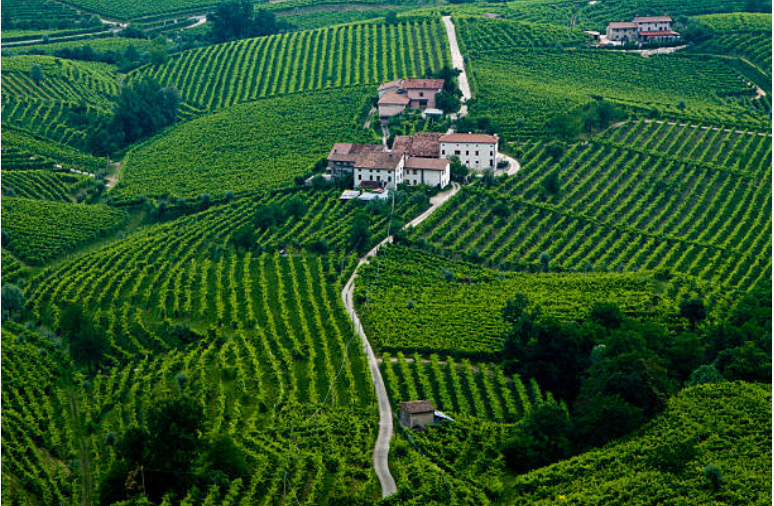
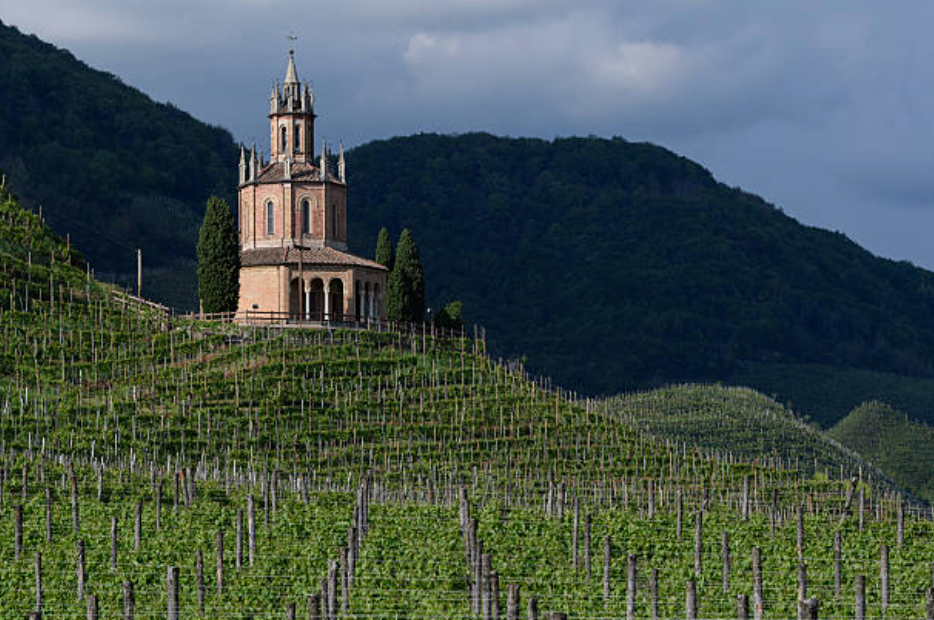
The hills between Conegliano and Valdobbiadene in the province of Treviso are the most topographically challenging wine-growing landscape in the Veneto. Steep hogback ridges with gradients of up to 70 percent are terraced with narrow strips of vineyard called ciglioni, too steep for machinery, maintained by hand across generations. The area was designated a UNESCO World Heritage Site in 2019, recognising it as an extraordinary cultural landscape shaped over centuries of viticulture.
The grape is Glera, a naturally aromatic variety that produces wines with freshness, floral fragrance, and the characteristic white peach and green apple character of good Prosecco. The method here is tank fermentation rather than bottle fermentation; secondary fermentation in pressurised steel vats (the Charmat or Martinotti method) preserves the grape’s delicate aromatics in a way that traditional method would not.
There are meaningful quality gradations within the DOCG. Rive bottlings come from named single vineyards within the 43 designated commune units, and carry a vintage on the label. At the very top sits Valdobbiadene Superiore di Cartizze, a micro-zone of just 107 hectares on steep south-facing slopes above Valdobbiadene that many consider the grand cru of Prosecco. The wines here have more body and persistence than standard DOCG bottlings, with a slightly richer, more complex character.
Lugana and Bardolino: Lake Garda’s Contributions
On the southern shores of Lake Garda, two appellations deserve more attention than they typically receive from visitors. Lugana DOC, centred on a band of calcareous clay moraine soil running along the lake’s southern shore, is built around Trebbiano di Lugana: a grape that here produces wines of surprising weight, mineral length, and the capacity to age. Zenato, one of the appellation’s most significant producers, has been instrumental in demonstrating what Lugana can achieve with serious winemaking.
Bardolino, on the eastern shore of the lake, produces light, cherry-bright reds from Corvina and Rondinella, and is worth exploring as a lighter-weight alternative to Valpolicella for the same grapes in a less demanding register.
Four Estates Worth Visiting
Masi Agricola, Gargagnago, Sant’Ambrogio di Valpolicella
Masi is probably the single producer most responsible for shaping the public understanding of Amarone and Valpolicella internationally. The estate’s president Carlo Boscaini is sometimes called “Mr Amarone”, a nickname earned through decades of research, advocacy, and winemaking that helped define the DOCG category. Masi also commercialised the Ripasso technique, creating one of the most commercially successful wine styles in Veneto.
The historic cellars at Gargagnago sit in the Classico zone, within the hamlet of Sant’Ambrogio di Valpolicella. A visit to Masi is structured around two sites: the Serego Alighieri estate, owned by descendants of the poet Dante Alighieri, whose family has lived in Valpolicella since 1353, and the main Masi winery a short walk away. Tours begin in the fruttaio, the drying loft where Corvina and Rondinella bunches rest on traditional bamboo racks through the winter months, monitored by sensors that track humidity and weight loss in real time. From there, visitors descend into the underground barrel cellars, multi-level and extensive, with art installations placed throughout, before returning to the Serego Alighieri estate for tasting.
Multiple tasting options are available, ranging from a four-wine introduction to deep vertical tastings of older vintages from the Cantina Privata Boscaini range. The vertical format, which traces a single wine across different years, is one of the better ways to understand how climate and ageing interact in Amarone.
Contact: Via Monteleone 26, 37015 Gargagnago di Valpolicella, Verona | wine.experience@masi.it | Tel +39 045 7703622 | masi.it
Cantina Pieropan, Soave
If there is one producer who has done more than any other to establish Soave Classico as a white wine worth serious attention, it is Pieropan. The estate was founded by Leonildo Pieropan, who spent much of the 1970s and 1980s demonstrating that the volcanic hills around the town of Soave were capable of producing wines of real depth and longevity, at a time when most of the world had written the appellation off.
The estate’s two single-vineyard wines, La Rocca and Calvarino, remain benchmarks for the category. La Rocca comes from a limestone outcrop on the slopes of Monte Rocchetta, above the medieval castle that gives the vineyard its name; unusually for the zone, this limestone soil sits in a sea of volcanic basalt, and the contrast in geology produces a wine of particular minerality and precision. Calvarino, on volcanic soils, shows more floral character and textural softness.
The estate’s new winery has attracted considerable attention since opening, with visitors noting how it manages to be technically sophisticated without feeling sterile. Tours take visitors through the production spaces, explain the Garganega grape’s particularities and the contrasting soil types, and conclude with a structured tasting of the Soave range. Marta and other guides at the estate have been consistently praised by visitors for the depth of their explanations and the warmth of the welcome.
Contact: Via Camuzzoni 3, 37038 Soave (VR) | info@pieropan.it | pieropan.it
Zenato, Peschiera del Garda
Zenato is an estate that spans two of the Veneto’s most compelling but geographically contrasting wine zones. Founded in 1960 by Sergio Zenato in the village of San Benedetto di Lugana on the southern shore of Lake Garda, the estate built its initial reputation on Lugana whites, producing some of the first evidence that Trebbiano di Lugana, then a largely dismissed grape, could be made into a serious, age-worthy wine. From that base, the family expanded into Valpolicella and Amarone.
Today, the Santa Cristina estate near Peschiera del Garda serves as the hub for visitor experiences. From here, guests can take in vineyards overlooking the lake, a backdrop that is difficult to fully prepare for, before descending into the barrel cellars where both Lugana wines and the flagship Amarone della Valpolicella are aged. The estate’s most prestigious label is the Sergio Zenato Amarone Riserva, produced only in the best years as a tribute to the founder, and aged in a combination of large oak casks and 500-litre tonneaux.
Tasting experiences at Zenato are structured and genuinely thoughtful. The standard tour culminates in a guided tasting of four to five wines paired with aged Parmigiano Reggiano, soppressa veneta (a traditional cured sausage), artisan bread, and extra virgin olive oil from the estate’s own trees. Private and tailored experiences are also available for those who prefer a more personal format. Advance booking is strongly advised, particularly in summer.
Contact: Via San Benedetto 8, 37019 Peschiera del Garda (VR) | info@zenato.it | zenato.it
Allegrini, Fumane, Valpolicella Classico
Allegrini is one of the Classico zone’s most progressive estates, and a visit here offers a useful counterpoint to the larger and more institutionalised Masi experience. Based in Fumane, at the heart of the Classico zone, the estate has been family-run for several generations and has developed a reputation for wines of elegance and precision rather than sheer weight.
The estate’s calling card is La Grola, a single-vineyard Valpolicella made from 100% Corvina from a terraced south-facing site above the valley floor, a wine that makes a compelling case for Corvina’s capacity to produce age-worthy, complex reds without the appassimento process. The Amarone is based on older-vine Corvina from the family’s best sites, and consistently shows a more floral, precise style than many Classico zone wines.
Visits are hosted in the spectacular Villa della Torre, a Renaissance palace completed in the sixteenth century and regarded as a landmark of Mannerist architecture. Tasting in these rooms, surrounded by carved fireplaces and frescoed walls, gives the experience a particular sense of occasion. The Valpolicella setting outside the estate- terraced hillside vineyards, cypress trees, the sound of something very old going on- is exactly what most visitors to this region are looking for.
Contact: Via Giare 9/11, 37022 Fumane (VR) | info@allegrini.it | allegrini.it
Wines to Buy Online Right Now
Dal Forno Romano Amarone della Valpolicella Monte Lodoletta: Colaris
Romano Dal Forno bottled his first Amarone in 1983. He learned his craft under Giuseppe Quintarelli, arguably the most revered figure in Valpolicella’s winemaking history. but quickly developed a style of his own: intensely concentrated, long-aged, built for decades of cellaring. The Monte Lodoletta vineyard in the Illasi valley, outside the Classico zone, forms the basis for both the Amarone and the Valpolicella Superiore.
The blend is predominantly Corvina, with Corvinone, Rondinella, Croatina, and Oseleta contributing structure and complexity. Grapes are selected late and dry until December or January, losing 30 to 40 percent of their weight. The wine is then aged for over two years in new French oak before further time in bottle. Dal Forno does not produce Amarone in every vintage, only in years where the fruit quality justifies it.
Colaris stocks multiple vintages of the Monte Lodoletta Amarone and Valpolicella Superiore, including the 2009, 2010, 2012, and 2013. Robert Parker awarded 95 points to the 2008, describing it as a wine of extraordinary darkness and intensity that would require significant cellaring before reaching its prime. These are not wines for opening tonight; they are investments in future experience.
Where to buy: colaris.nl
Zenato Amarone della Valpolicella Riserva Sergio Zenato: Wijnbeurs and Colaris
The Riserva Sergio Zenato is produced only in exceptional years and represents the estate’s most serious statement on what Valpolicella’s Classico zone can produce. Aged for an extended period in a combination of large Slavonian oak casks and tonneaux, the wine typically shows a more classical profile than modern-style Amarones, dried cherry, tobacco, dark chocolate, Mediterranean herb, and the mineral salinity that the lake-influenced climate of this western part of Valpolicella adds.
Wijnbeurs carries a strong selection of Veneto reds including Amarone, and Colaris lists both the Zenato Riserva and other Amarone producers across the appellation. The standard Zenato Amarone della Valpolicella is also a reliable option at a more accessible price point for those who want to understand the estate’s style before committing to the Riserva level.
Where to buy: wijnbeurs.nl | colaris.nl
Pieropan La Rocca Soave Classico: Decantalo
The La Rocca is the wine that most convincingly dismantles the assumption that Soave is a simple category. Produced from 100% Garganega grown on the unusual limestone soils of the Monte Rocchetta slope, it is fermented partially in stainless steel and partially in 500-litre oak casks, then aged for a further period before release. The result is a wine of golden yellow colour with a distinctly complex nose, nuts, exotic fruit, acacia honey, and a stony mineral undercurrent, and a palate that balances richness with genuine precision.
The 2021 vintage received strong marks from Wine Enthusiast, with critics noting the wine’s profound balance and the way its mineral depth emerges as it opens in the glass. The 2022 was similarly well received, with reviews pointing to its layers of ripe golden apple, jasmine, and toasted almond against a background of concentrated minerality. Decantalo typically stocks the most recent available vintage.
This is a wine that rewards patience in the cellar and repays the investment. For those who associate Soave with cheap bulk wine from the 1980s, this is the bottle to serve to prove how wrong that assumption is.
Where to buy: decantalo.com
Masi Costasera Amarone della Valpolicella Classico: Wijnbeurs
The Costasera is Masi’s most widely available Amarone and, at its price point, one of the most reliable benchmarks in the appellation. Made from grapes grown in the Classico zone, it blends Corvina Veronese, Rondinella, Molinara, and a small amount of Oseleta, the ancient variety that Masi reintroduced to Valpolicella in the 1990s and which adds dark spice and structural grip to the blend. The wine ages for two years in a combination of large Slavonian casks and small barriques before release.
On the nose, mature vintages show classic Amarone character: dried cherry, cocoa, dried herbs, and cedar, with the dark, slightly oxidative tone that comes from the drying process. The palate is generous and warming, with tannins that soften considerably with a decade of cellaring. The 2016 and 2017 vintages, where available, are drinking well now.
Wijnbeurs carries a consistent range of Amarone della Valpolicella, including options across price points, from approachable entry-level bottles to more serious single-vineyard expressions. Their blind tasting assessment system means every bottle on their list has been evaluated for quality before listing.
Where to buy: wijnbeurs.nl
Planning Your Visit to the Veneto Wine Region
Base Yourself in Verona
Verona is the obvious hub for anyone focusing on Valpolicella, Soave, and Lake Garda. The city itself is extraordinary: the Roman arena, the medieval streets, the Adige River curve, and it sits within 20 minutes of the Classico zone vineyards. The drive north toward Fumane and Negrar takes you into the hills quickly, and the villages in between (Pedemonte, San Ambrogio, Gargagnago) are as calm and unaffected as wine-touring landscapes get.
For Soave, the drive east from Verona is about 30 minutes. The medieval town itself is worth the visit independent of wine; the castle that gives La Rocca its name dominates the hill above and is open to visitors.
Lake Garda is easily combined with a Valpolicella day; the western shore requires a longer drive from Verona, but the southern end of the lake, where Zenato is based near Peschiera del Garda, is less than 40 minutes. The lake adds a visual reward to what might otherwise be a day of cellar visits.
For Prosecco, the hills of Conegliano and Valdobbiadene are better accessed from Treviso or Venice. They sit about 90 minutes northeast of Verona, and the landscape there is dramatic enough to warrant an overnight stop. Stay in Valdobbiadene or one of the small hill villages above it, and spend a morning on the terraced slopes before the rest of the world arrives.
When to Go
September through early November is the best window for capturing the harvest in progress. In Valpolicella, early October sees the fruttai filling up, bunches of Corvina arriving on bamboo racks as the autumn air begins to cool and the drying process begins. This is when a winery visit feels most alive.
For Prosecco, late spring and early summer offer the cleanest weather and the freshest landscapes before the tourist season peaks. The hills are green, the vines are flowering, and the ciglioni terraces are accessible on foot without the heat that settles in August.
Lake Garda is worth visiting in shoulder season, May, June, or September, when the lakeside towns are not overwhelmed. Verona’s peak tourist season runs July and August; book accommodation and winery visits earlier than feels necessary.
Getting Around
As with most Italian wine regions, a car is the most efficient way to move between appellations. The roads within the Classico zone are narrow and winding through the villages, but distances are short; you can visit three or four estates in a single day without covering more than 40 or 50 kilometres.
If you are based in Venice, day trips to Prosecco country by train to Treviso followed by car hire are manageable. For Verona’s wine zones, the high-speed train from Venice (approximately 80 minutes) gives easy access, with car hire available at Verona Porta Nuova station.
One consideration: Amarone at 16% alcohol is not conducive to driving between multiple estates. A designated driver or a guided tour with transfer included makes practical sense for serious tastings.
A Vintage Note on the Key Appellations
For Amarone della Valpolicella, 2015, 2016, and 2019 are widely considered outstanding vintages in the recent era. 2015 produced wines of great ripeness and power; 2016 added precision and freshness that the best producers translated into exceptional age-worthiness; 2019 brought elegance and consistency. The 2017 vintage was warm and generous, accessible earlier than the preceding years. When shopping for Amarone to drink in the next three to five years, 2016 and 2017 are sensible targets. For long-term cellaring, 2015 and 2019 deserve attention.
For Soave Classico, the vintage chart matters less than in Amarone; the style tends toward freshness and the wines are generally consumed within five to eight years, though La Rocca and Calvarino from strong years can comfortably age beyond a decade. The 2021 and 2022 vintages produced wines of good balance and freshness.
Prosecco is a non-vintage category by default, though Rive bottlings carry a vintage. Look for the most recent harvest year on Rive labels, as freshness is the defining quality.
Final Thoughts
The Veneto rewards the visitor who resists the obvious choices. It is easy to drink a glass of Pinot Grigio at a Venice bacaro and leave with no deeper understanding of what this region can produce. It takes a little more intention to drive up into the Classico zone at harvest, watch the fruttai filling with drying Corvina, and understand what months of slow dehydration do to a grape before it becomes Amarone. It takes a day to drive east to Soave and understand why the volcanic hilltop vineyards have so little to do with the flat-plain Soave you may have encountered in the past.
That effort pays off in ways that are difficult to explain at a single tasting. The Veneto’s best wines are not easy; they ask something of you, whether that is patience in the cellar, attention at the table, or simply a willingness to set aside assumptions about what a region can do. The four estates above, and the bottles linked to them, are as good a starting point as any.