Rheinhessen: Germany’s Most Exciting Wine Region and Why It Deserves Your Full Attention
There is a particular satisfaction in watching a wine region reinvent itself without losing its identity. The Rheinhessen wine region has done exactly that over the past two decades, evolving from a producer best known for semi-sweet bulk wines into one of Germany’s most compelling destinations for serious wine lovers. With 27,657 hectares of vineyards spread across the rolling landscape between Mainz, Bingen, and Worms, it is Germany’s largest wine-producing region by area, and increasingly its most talked-about.
Having spent time tasting through the region’s benchmark bottlings and following the estates that have driven this quality revolution, I find Rheinhessen consistently surprising: in the diversity of its terroirs, the ambition of its producers, and the sheer range of styles it is capable of producing at the highest level.
This guide is written for the wine lover who already knows the basics of German wine and wants to go deeper. If you are ready to move beyond the familiar faces of the Mosel and Rheingau, Rheinhessen is where that conversation gets genuinely exciting.
A Region That Had to Earn Its Reputation Back
For much of the 20th century, Rheinhessen was the engine room of German export wine. The region was responsible for vast quantities of Liebfraumilch, the sweetened Müller-Thurgau-based wine that once dominated British supermarket shelves and quietly eroded confidence in German wine as a whole. Even wines marketed under more prestigious-sounding names: Niersteiner Gutes Domtal being the most notable example – were in reality broad regional blends that had little connection to the exceptional single-vineyard sites they implied.
The turnaround began in earnest in the late 1980s and accelerated through the 1990s and 2000s, driven by a generation of winemakers willing to significantly reduce yields, push for organic and biodynamic farming, and make the case for dry Riesling as a serious international wine style. Two names above all others are credited with anchoring this transformation on the international stage: Weingut Keller and Weingut Wittmann. Their influence on the wider region is hard to overstate. Talk to almost any winemaker in Rheinhessen today, and both names come up as touchstones, proof that a winemaker, not just a famous vineyard, can bring a region to attention.
Rheinhessen joined the Great Wine Capitals Global Network in 2008, a membership it shares with Bordeaux, Mendoza, Napa Valley, and Porto, among others. Mainz, the state capital and gateway to the region, is recognised as Germany’s wine capital. For a region that had to fight hard to reclaim its credibility, these are not small things.
Understanding Rheinhessen’s Geography and Terroir
The Triangle: Bingen, Mainz, Worms
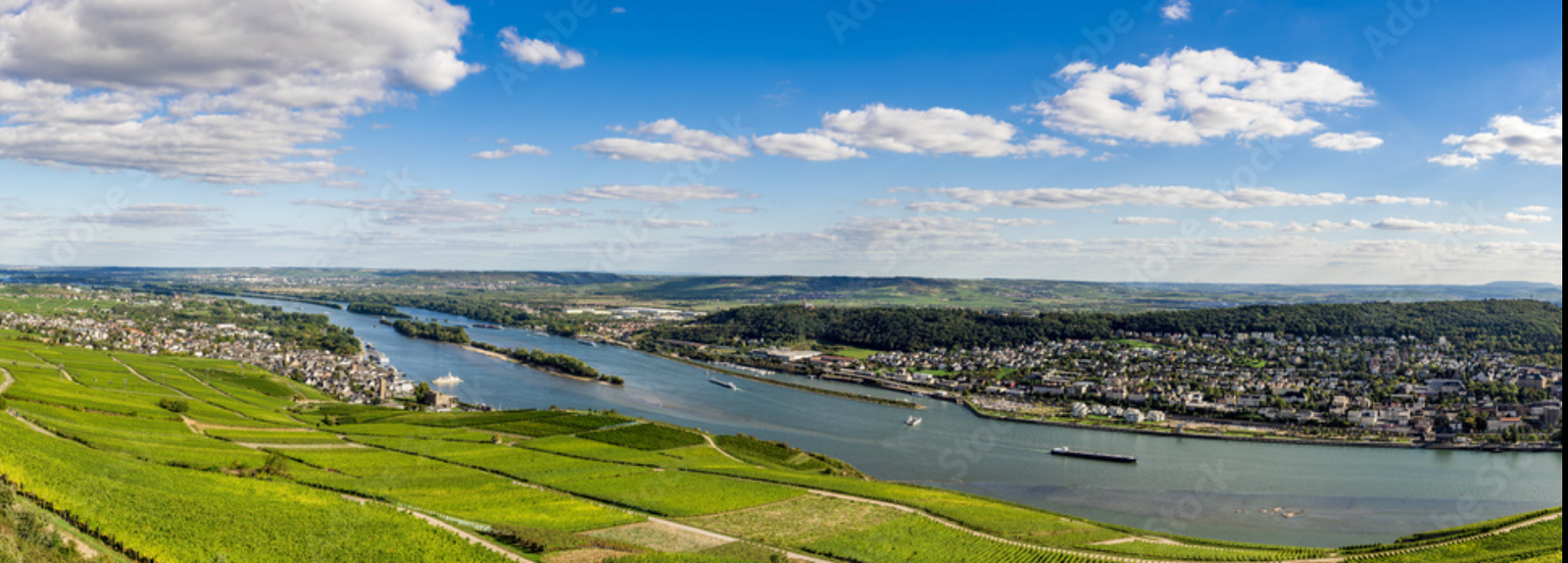
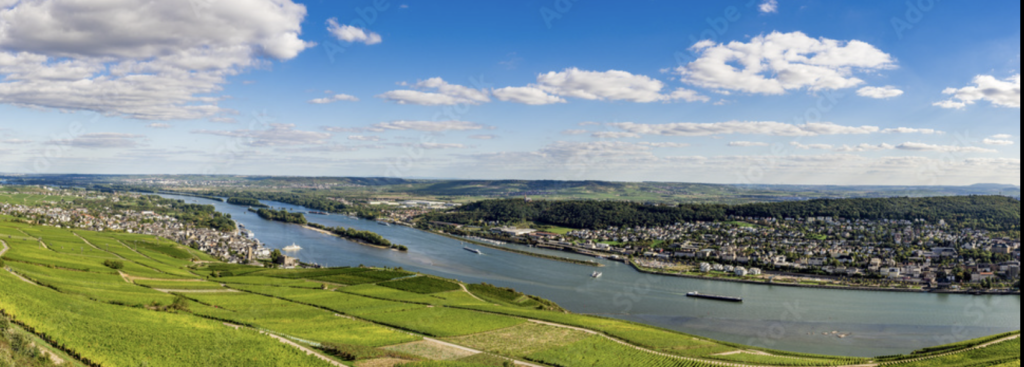
Rheinhessen sits on the left bank of the Rhine in the federal state of Rhineland-Palatinate, enclosed within a rough triangle formed by Bingen in the northwest, Mainz in the northeast, and Worms in the south. On three sides, the region is protected by the Hunsrück, Taunus, and Odenwald ranges, as well as the Palatinate uplands to the southwest. This natural shield creates one of Germany’s driest and most thermally stable growing climates; annual rainfall averages around 500mm, which gives winemakers unusual latitude in managing ripeness without the intervention required in wetter regions.
The landscape itself is one of rolling hills and wide plains rather than the dramatic river-carved slopes of the Mosel or Rheingau. Much of the interior is covered by loess, limestone, and clay-loam soils that produce generous yields but require careful farming to achieve genuine concentration.
The Roter Hang – Red Slate on the Rhine
The most distinctive single geological feature in Rheinhessen is the Roter Hang, or “Red Hillside,” a continuous strip of steep vineyard running roughly from Nackenheim south through Nierstein. The name describes the iron-rich, red-weathered clayey slate that formed here over 280 million years ago, a soil type entirely unlike the limestone that dominates the region’s interior.
The Roter Hang faces east to southeast, looking directly across the Rhine. The combination of reflected light from the water, exceptional heat retention in the dark slate, and the natural drainage of steep slopes produces Rieslings of a very specific character: spicy, savoury, with iron-inflected minerality and a depth of texture that distinguishes them immediately from anything coming off the limestone hills further west. Individual sites like Pettenthal, Hipping, Ölberg, and the Nackenheimer Rothenberg are recognised as among the great Riesling vineyards of Germany, the equivalent, in compositional depth and ageing potential, of Grand Cru terroir in Burgundy.
The Wonnegau – Limestone Precision
The southern subregion of Wonnegau, centred around the villages of Westhofen, Flörsheim-Dalsheim, and Alzey, operates on a completely different geological logic. Here the dominant soils are limestone and marl, sometimes with significant clay content, producing wines with a cooler energy and a crystalline precision that is less about warmth and texture and more about tension and drive.
This is Keller country and Wittmann country, producers who have used the Wonnegau’s Grosse Lage vineyards like Kirchspiel, Morstein, and Aulerde to build an argument for limestone-grown Riesling that rivals anything in the German canon. The wines often need more time in the bottle than Roter Hang bottlings before they reveal their full complexity, but the reward for patience is considerable.
Souvignier Gris and the Push for New Varieties
One marker of Rheinhessen’s restless innovation is the rapid expansion of PIWI varieties, disease-resistant grape crossings that require minimal chemical intervention. Souvignier Gris, in particular, has seen remarkable growth: from 96 hectares in 2023 to 248 hectares in 2025, more than doubling in two years. This makes Rheinhessen the national leader in what is arguably the most commercially interesting new white variety being cultivated in Germany. Expect to see it appear with increasing frequency on serious wine lists as the planted vines reach full maturity.
The Grape Varieties You Need to Know
Rheinhessen is unusual among German wine regions in the breadth of its varietal range. White varieties account for around 75% of plantings, but the palette extends well beyond the Riesling-centric model of the Mosel or Rheingau.
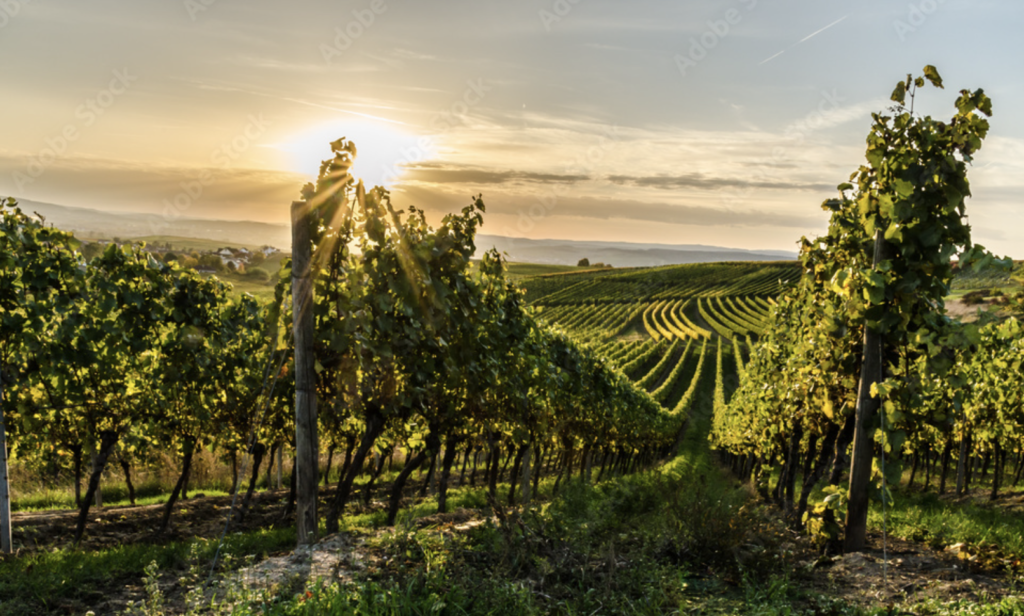
Riesling is the prestige grape, with 5,471 hectares making Rheinhessen Germany’s second-largest Riesling region after the Pfalz. The range of styles is vast: from the mineral austerity of Roter Hang GG to accessible entry-level Ortsweine that punch well above their weight at modest prices.
Silvaner is Rheinhessen’s signature secondary variety, with more hectares planted here than anywhere else in Germany, including Franken where the grape is often assumed to belong. At its best, from producers like Thörle, Keller, and Dreissigacker, Silvaner from Rheinhessen produces wines of startling complexity: earthy, saline, with a quiet authority that repays ten or fifteen years of ageing. The regional designation RS (Rheinhessen Silvaner) was Germany’s first “profile wine,” subject to strict tasting panel approval before release.
Grauburgunder (Pinot Gris) has grown to 2,462 hectares, making Rheinhessen Germany’s most important region for the variety, ahead of Baden. The warmer continental climate encourages full-bodied expressions with stone fruit and spice.
Spätburgunder (Pinot Noir) from limestone soils around villages like Saulheim, Oppenheim, and Bodenheim produces genuinely elegant red wines. Estates like Thörle have built international reputations specifically on their Pinot Noir from these calcareous sites.
Chardonnay has found a comfortable home here too, with 1,187 hectares making Rheinhessen Germany’s leading Chardonnay region. Producers working with biodynamic farming and spontaneous fermentation are producing Chardonnays with more in common with Burgundy than most people expect.
Four Estates Worth Making the Journey For
Weingut Keller – Flörsheim-Dalsheim, Wonnegau
If you follow fine wine at all seriously, you already know the name Keller. Klaus-Peter Keller and his wife Julia have built what is widely considered the reference estate not just of Rheinhessen but of German wine as a whole, working from the small village of Flörsheim-Dalsheim on 21 hectares of predominantly limestone soils. The estate traces its origins to 1789 when Johann Leonhard Keller, emigrating from Switzerland, purchased the Oberer Hubacker vineyard, a parcel that remains central to the estate today.
Three generations now live and work under one roof, including Klaus-Peter’s son Felix, who is increasingly involved in both vineyard and cellar. The estate produces around 100,000 bottles per year across a portfolio that spans multiple Grosse Lage (Grand Cru) sites including Kirchspiel, Morstein, Aulerde, Brunnenhäuschen, and Hipping. At the apex is G-Max, a wine whose precise vineyard origins Klaus-Peter has never disclosed, which holds the record as the world’s most expensive dry Riesling.
The Keller approach in the cellar is one of minimal intervention: spontaneous fermentation, extended ageing on fine lees, and bottling without fining or heavy filtration. The wines rarely reveal their full complexity before five years from vintage; the best examples need a decade or more.
Visiting: Keller does not operate walk-in tastings. Appointments can be requested directly through the estate’s website (keller-wein.de). Be aware that allocation lists for the top wines are long and waiting times can stretch over several years. A visit to taste through the estate range, including the more accessible Weissburgunder and Silvaner bottlings, is worth every effort to arrange.
Address: Bahnhofstraße 1, 67592 Flörsheim-Dalsheim
Weingut Wittmann – Westhofen, Wonnegau
Wittmann is Keller’s nearest peer in reputation and, in many ways, its philosophical counterpart. Where Keller’s wines tend toward concentration and textural weight, Wittmann’s are defined by precision, energy, and a particular mineral purity that reflects the estate’s commitment to biodynamic farming. The family has been making wine in Westhofen since 1663, the estate first documented as a leasehold of the Electoral Palatine, and became a VDP member in 1998.
Today it is Philipp Wittmann who leads the winemaking, working across 28 hectares of organic and biodynamically farmed vineyards that include three VDP Grosse Lage sites: Morstein (which Wittmann shares with Keller and a handful of other estates), Aulerde, and Kirchspiel. The Morstein Grosses Gewächs is arguably the estate’s signature wine, a Riesling of sculpted, almost architectural precision that gains in stature with every year in bottle.
Beyond Riesling, Wittmann produces impressive Weissburgunder and a Chardonnay that regularly outperforms wines costing significantly more. The estate also makes a small quantity of sparkling wine under the Sekt designation.
Visiting: Wittmann welcomes visitors by appointment, and the experience tends to be personal and unhurried. The estate’s courtyard setting in Westhofen gives the visit an authentic, working-farm character that is a world away from the polished tourism setups of larger wine regions.
Address: Mainzer Straße 19, 67593 Westhofen | Website: weingutwittmann.de
Weingut Gunderloch – Nackenheim, Roter Hang
For Riesling from the Roter Hang at its most expressive, Gunderloch is the essential reference. The estate was founded in 1890 by a Mainz banker named Carl Gunderloch and today is run by sixth-generation winemaker Johannes Hasselbach, who took over from his parents Fritz and Agnes in 2016. Johannes leads the Rheinhessen regional association of the VDP and achieved organic certification for the estate in 2022.
The vineyards centre on the Nackenheimer Rothenberg, a 6.5-hectare Grosse Lage site that Gunderloch dominates, as well as Pettenthal and Hipping in Nierstein. All of these sit on the distinctive iron-rich red slate of the Roter Hang, the soils that give Gunderloch wines their immediately recognisable character: a smokiness in the nose, a sense of warm mineral extract, and a finish that can sustain for what seems like an unreasonable amount of time.
The estate exports to 34 countries and is one of the most accessible of Rheinhessen’s top producers in terms of international retail distribution. The Nierstein Riesling, drawn from young vines on the Pettenthal, offers genuine grand cru character at a fraction of the price of the single-vineyard bottlings, and is one of the best value-for-money propositions in German wine.
Visiting: Gunderloch offers tastings by appointment. The estate’s sales office is in Nackenheim, with the vineyards visible along the steep Rhine-facing slope directly above.
Address: Carl-Gunderloch-Platz 1, 55299 Nackenheim | Website: gunderloch.de
Weingut Thörle – Saulheim, Central Rheinhessen
Thörle represents the next chapter in the Rheinhessen story. Brothers Christoph and Johannes Thörle took over their family estate in Saulheim in 2006 and have steadily transformed it into one of the region’s most admired producers, building their reputation on both Riesling and Pinot Noir from three Grosse Lage vineyards: Saulheimer Schlossberg, Probstey, and Hölle.
The soils in Saulheim are limestone and clay-marl with loess topsoils, excellent for both white and red varieties. The estate is certified organic and practices biodynamic farming, with spontaneous fermentation and minimal intervention in the cellar. The Rieslings from Schlossberg are among the most precise and structured in the region, while the Probstey site produces Riesling and Silvaner with a more voluminous, sun-saturated character.
What makes Thörle particularly interesting for the advanced wine lover is the red wine programme. Their Spätburgunder is consistently cited as among the best Pinot Noir in Germany: complex, fine-boned, with an evident Burgundian sensibility in the approach to fermentation and barrel ageing.
Visiting: Thörle operates as a working estate rather than a visitor centre, but tastings can be arranged by contacting the estate directly. The experience is appropriately no-ceremony and deeply informative.
Address: Steingasse 2, 55291 Saulheim | Website: weingut-thorle.de
Wines to Buy Online
One of the pleasures of Rheinhessen is that the quality range extends from approachable, reasonably priced entry-level Rieslings to bottles that require years of advance planning to source. Below is a selection across that range, with notes on where to find them.
For the Benchmark Bottle – Gunderloch Nierstein Riesling
This wine represents one of the most reliable quality-to-price propositions in German Riesling. Drawn from young vines on the Pettenthal site, it delivers genuine Roter Hang character, the smokiness, the mineral depth, the long saline finish, at a price that sits well below the estate’s single-vineyard Grosses Gewächs bottlings. It is typically ready to drink within two to three years of vintage but gains considerably with five or more.
Where to buy: Gunderloch wines are distributed across Europe and can be found via the estate’s own online shop at gunderloch.de, as well as through Decantalo and specialist German wine merchants. Search Decantalo for “Gunderloch Nierstein” for the most recent available vintage.
For the Silvaner Enthusiast – Thörle Saulheimer Silvaner
Thörle’s Silvaner is a compelling argument for the variety as something other than a supporting act. From the limestone soils of Saulheim, it delivers the earthy, almost saline character that Silvaner can produce when farmed seriously, with more structure and length than you might expect, and an ageing trajectory that easily reaches a decade.
Where to buy: Thörle wines are available directly from the estate (weingut-thorle.de) and through specialist importers. Check Colaris and fine German wine specialists in the Netherlands and Belgium for current stock.
For the Wonnegau Riesling Experience – Wittmann Westhofener Riesling
Wittmann’s village-level Riesling from Westhofen is the estate’s calling-card wine: accessible in youth, dry and precise, with the limestone-driven minerality that defines the Wonnegau style. It is typically available from Wijnbeurs and other Dutch wine retailers who stock a curated German selection, and offers a genuine introduction to what Wittmann is doing at the top of the quality pyramid for a fraction of the Grosses Gewächs price.
Where to buy: Check wijnbeurs.nl for current German wine listings, where Wittmann regularly features in the range. The estate also sells directly at weingutwittmann.de/en.
For the Daring Investment – Keller G-Max Riesling
G-Max occupies a category of its own in German wine. The price is high, and has been climbing, but the wine itself justifies serious attention. It is fermented in large wooden barrels with naturally occurring yeasts, aged on fine lees for an extended period, and bottled without clarification. The result is a Riesling of extraordinary concentration, with what critics describe as a finish that lasts for minutes rather than seconds. Whether you find a bottle at auction, through a specialist retailer, or via a long relationship with an importer, it is worth experiencing at least once.
Where to buy: G-Max is allocated and rarely available at retail. The estate’s mailing list (keller-wein.de) is the primary route to allocation. Wine auction platforms and specialist merchants occasionally have back vintages available. Colaris and some Belgian and Dutch fine wine retailers carry Keller’s more accessible Ortswein and Erste Lage bottlings, which provide a more available entry point to the style.
The Organic Biodynamic Choice – Battenfeld-Spanier Riesling Vom Kalkstein
For those drawn to biodynamic production, Battenfeld-Spanier (the sister estate to Kühling-Gillot, both run by Carolin Spanier-Gillot and H.O. Spanier) produces a Riesling Vom Kalkstein that is both a fair introduction to the estate’s style and a genuine expression of Wonnegau limestone terroir. Dry, taut, with vibrant acidity and a mineral salinity on the finish, it rewards decanting and patience.
Where to buy: Available through specialist importers across Europe. Check Colaris for listings or contact the estate directly at kuehlingandbattenfeld.com.
Planning a Visit to Rheinhessen
Getting There
Mainz is the natural base for a Rheinhessen wine trip and is well connected by train from Frankfurt Airport (approximately 40 minutes by regional train). A car is necessary for visiting the more dispersed interior estates around Westhofen, Saulheim, or Flörsheim-Dalsheim, but the Roter Hang villages of Nierstein and Nackenheim are close enough to Mainz to be reached by bus or taxi.
When to Visit
The most active time in the region is autumn, when harvest begins (typically September through October) and estates are at their most energetic. The Mainzer Weinbörse wine fair takes place in spring and draws producers from across the region. For a more relaxed visit, late spring and early summer are ideal; the vineyards are in full leaf, temperatures are pleasant, and most estates can accommodate visits before the pressure of harvest begins.
Structuring Your Trip
The geography of Rheinhessen rewards a two- or three-day visit, splitting time between the Rhine-facing Roter Hang in the east and the Wonnegau in the south.
For a focused Roter Hang itinerary, base yourself in Mainz or Nierstein and visit Gunderloch, Kühling-Gillot in Bodenheim, and the smaller estates around Nackenheim. The steep vineyard paths above Nierstein offer views down to the Rhine that explain immediately why these sites produce the wines they do.
For the Wonnegau, the village of Westhofen is the epicentre, with Wittmann as the anchor visit. Keller in Flörsheim-Dalsheim and Thörle in Saulheim can reasonably be combined in a single day, though both merit longer.
The Bottlestops guided tour operator, winner of the Best of Wine Tourism Award 2022 for Innovative Wine Tourism Experiences, runs day tours departing from Mainz and partners with a rotating selection of the region’s better producers. For first-time visitors to the region, a guided day with Bottlestops provides an efficient and genuinely informative introduction before you start making independent appointments with individual estates.
The VDP and What It Means in Rheinhessen
Understanding the VDP classification system is essential to navigating Rheinhessen at the quality end. The Verband Deutscher Prädikatsweingüter (VDP) is Germany’s association of premium estates, and its classification of vineyards into a four-tier hierarchy. Grosse Lage, Erste Lage, Ortswein, and Gutswein, provide a Burgundy-style framework that applies to all VDP member estates.
In Rheinhessen, VDP membership includes Keller, Wittmann, Gunderloch, Kühling-Gillot, Battenfeld-Spanier, Thörle, Heyl zu Herrnsheim, and others. Wines designated Grosses Gewächs (GG) come from Grosse Lage vineyards and must be dry. They are typically released in September of the year following harvest and represent the apex of what each estate can produce.
For the wine buyer, the VDP designation provides a reliable signal of both quality intent and terroir specificity. A VDP estate GG from Rheinhessen can be compared directly, and favourably, with First Growth or Grand Cru equivalents from other European regions.
Rheinhessen and Food – A Natural Pairing
The region’s wine diversity maps naturally onto a wide range of food cultures. Riesling from the Roter Hang, with its pronounced minerality and firm acidity, is an exceptional partner for freshwater fish from the Rhine; pike-perch, carp, and trout all appear regularly on local menus, as well as Asian cuisine and anything with significant citrus or herb character.
Wonnegau Riesling, with its rounder texture and stone fruit character, works beautifully with asparagus (a regional speciality in season), seafood risotto, and poultry with cream-based sauces.
Silvaner is perhaps the most food-friendly variety the region produces: its low aromatic intensity and moderate acidity allow it to complement rather than compete with a remarkable range of dishes, from fresh goat’s cheese to grilled vegetables to light pork preparations.
The red wines, particularly Spätburgunder from limestone sites, call for duck, mushroom dishes, and aged hard cheeses. Thörle’s Pinot Noir, in particular, deserves to be served in proper Burgundy glasses and given the same reverent attention you would offer a village-level Gevrey.
Why Rheinhessen Rewards Deeper Exploration
There is a certain irony in the fact that the same region that produced Liebfraumilch now produces some of the world’s most coveted dry Rieslings. The transformation is real, sustained, and continuing. New estates are emerging from the Wonnegau and the central hinterland with each passing vintage, and the combination of serious VDP producers, ambitious organic farmers, and a younger generation of winemakers who spent time in Burgundy and the Mosel before returning home makes Rheinhessen one of the most intellectually stimulating wine regions to follow right now.
For the advanced wine enthusiast, the region offers something increasingly rare: the opportunity to be genuinely surprised. The wines at the top level can sit comfortably alongside Grand Cru Burgundy and premier Mosel GGs in any serious tasting. The entry-level wines: Ortsweins and estate Rieslings from producers like Thörle, Wittmann, and Gunderloch, offer quality at prices that more famous regions stopped offering years ago.
Germany’s largest wine region is no longer defined by its volume. It is defined by its ambition, its diversity, and a generation of winemakers who understood exactly what the land beneath their feet was capable of producing when treated with the care it deserved.