Loire Valley Wine Region: A Guide to Sancerre, Chinon, Savennières & Muscadet
Most wine regions ask you to understand one grape, one soil type, one climate. The Loire Valley asks something different: it asks you to follow a river for over 600 miles and accept that the wine in your glass will change dramatically depending on which stretch of that river you’re standing beside. Briny Muscadet near the Atlantic coast has almost nothing in common with the smoky, mineral Sauvignon Blanc of Sancerre four hours upstream by car, and the age-worthy Cabernet Franc of Chinon sits somewhere in style between the two, on tuffeau limestone unlike either.
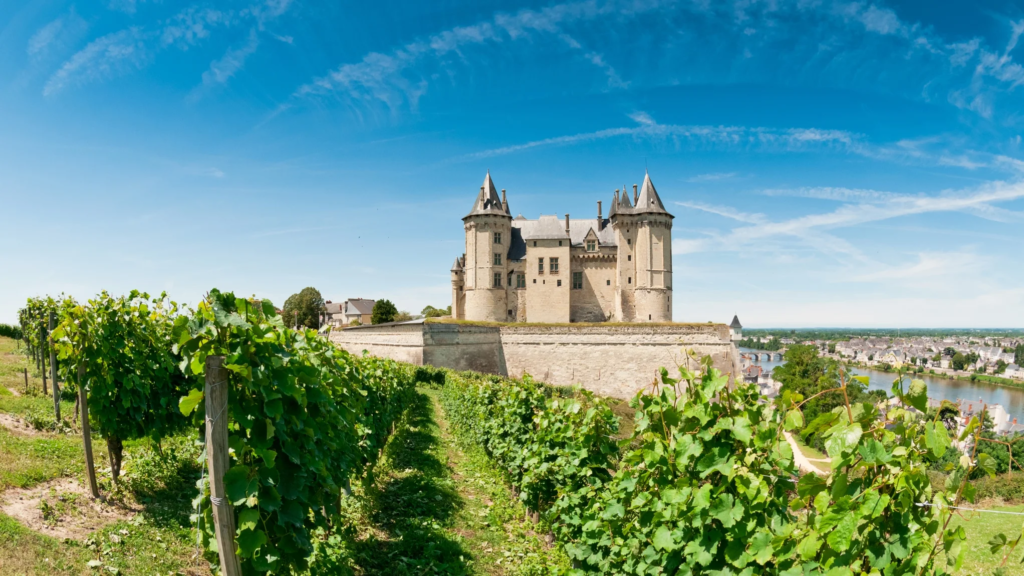
This stretch of central and western France produces every wine style there is, dry, sweet, sparkling, red, white, and rosé, often from a single grape variety grown differently across its various pockets. Chenin Blanc alone runs from bone-dry Savennières to the lusciously sweet Quarts de Chaume, sometimes from vineyards a few kilometers apart. That range is precisely what makes the Loire rewarding for a reader who already knows Bordeaux and Burgundy and wants a region that keeps surprising rather than confirming what they already expect.
This guide covers the Loire’s four main sub-regions, the grapes that define each one, four estates spanning Savennières, Chinon, Sancerre, and the broader Anjou-Saumur area, and where these wines can genuinely be found at Dutch and Spanish retailers.
Geography and Terroir
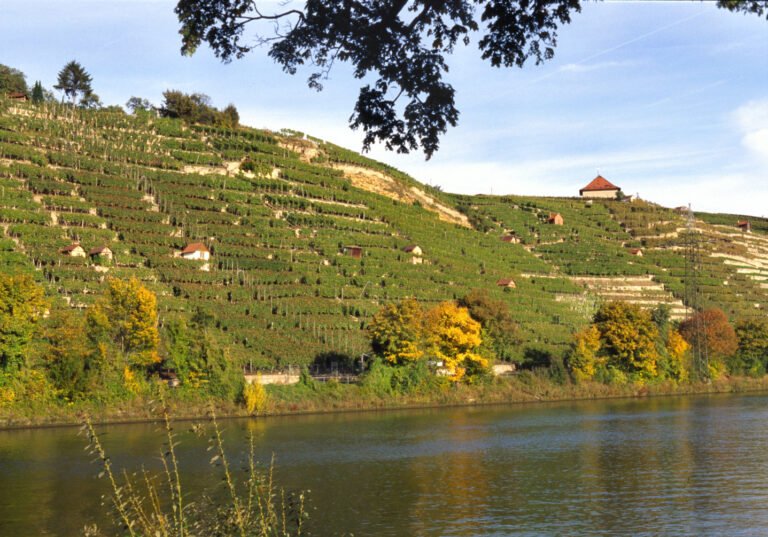
The Loire Valley wine region is best understood as four distinct zones strung along the river as it flows northwest from central France to the Atlantic at Nantes.
Pays Nantais, the westernmost and lowest-lying zone, sits close enough to the Atlantic to feel genuinely maritime, with volcanic, granite, and serpentinite soils. This is Muscadet country, where the Melon de Bourgogne grape produces bone-dry, saline white wine built for oysters and shellfish, often aged sur lie (on its lees) to add texture without adding weight.
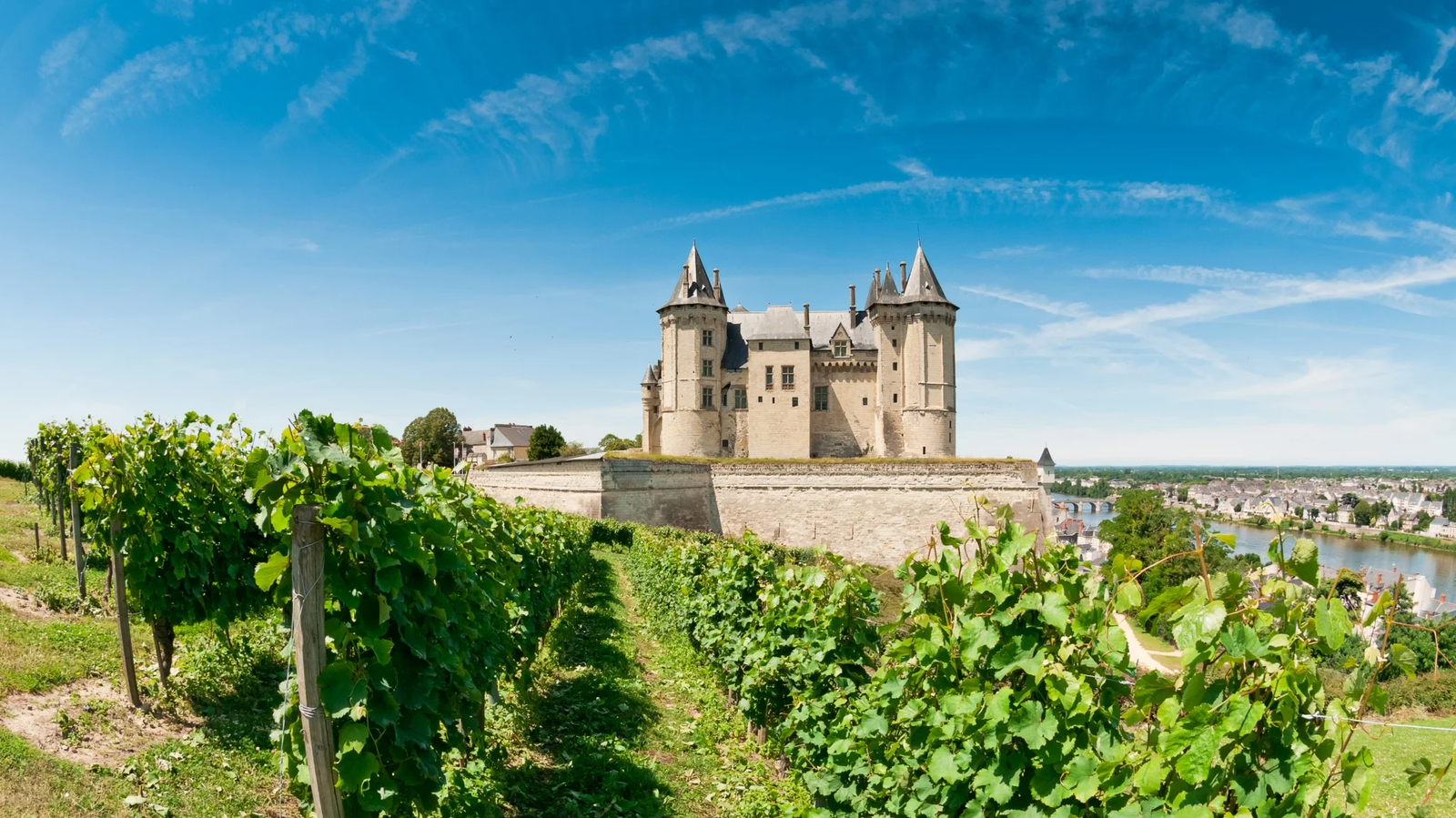
Anjou-Saumur, moving upstream around Angers and Saumur, sits on a geological fault line, with schist dominating around Savennières and softer tuffeau limestone becoming more common further east toward Saumur. This is Chenin Blanc’s heartland, capable of everything from the powerful dry whites of Savennières to the botrytized sweet wines of Coteaux du Layon and Quarts de Chaume, alongside Cabernet Franc-based reds and the traditional-method sparkling Crémant de Loire.
Touraine, centered on the city of Tours, is where tuffeau limestone, the same pale, chalky stone used to build many of the Loire’s châteaux, becomes the defining soil type. Chinon, Bourgueil, and Vouvray all sit within Touraine, and this is where Cabernet Franc reaches its most serious expression in appellations like Chinon, while Vouvray does the same for Chenin Blanc, both dry and sweet.
The Upper Loire (sometimes called Centre-Loire), furthest from the Atlantic and closest to Burgundy in both geography and spirit, is Sauvignon Blanc territory, home to Sancerre and Pouilly-Fumé. Flinty silex soils here give the grape its distinctive smoky edge, while limestone (caillottes) and marl (terres blanches) plots produce softer, rounder expressions of the same variety.
Climate shifts accordingly, from genuinely maritime in the west to increasingly continental moving east, which is part of why a single grape like Chenin Blanc or Cabernet Franc can taste so different depending on where along the river it grows.
A Short History
Winemaking along the Loire predates most of France’s other major regions in continuous production, with evidence of Roman-era viticulture along the river’s banks. But the Loire’s real commercial rise came through its relationship with Dutch and English merchants, who by the Renaissance were major buyers of the region’s white wines, so much so that Chinon, now almost entirely a red wine appellation, was once a significant center of white wine production largely to satisfy Dutch demand.
The river itself was historically the region’s economic backbone, a navigable trade route linking inland vineyards to the Atlantic ports before railways reshaped French commerce in the 19th century. This is also, unavoidably, château country: the same tuffeau limestone quarried to build Chenonceau, Amboise, and Chambord left behind vast underground cave networks, many of which now serve as natural, temperature-stable wine cellars still in use today, particularly around Vouvray and Saumur.
Sancerre’s rise to international fame is comparatively recent. For much of its history, it was considered a regional curiosity; its emergence as the global reference point for Sauvignon Blanc largely dates to the mid-20th century, driven by a handful of ambitious growers willing to farm its steep, difficult slopes with real precision.
The 20th century also brought phylloxera, the root louse that devastated European vineyards, and the Loire’s response shaped some of its more unusual traditions. Certain producers, particularly in Sancerre, still maintain small plots of ungrafted, pre-phylloxera-style vines planted on their own rootstock, a practice considered both a technical curiosity and a genuine link to how these vineyards tasted before the epidemic. These francs de pied plantings are rare and typically bottled separately, commanding prices well above the estate’s standard cuvées precisely because of their scarcity and historical significance.
Grape Varieties
The Loire’s defining characteristic is how differently a small handful of grapes perform depending on where they’re planted.
Chenin Blanc, the Loire’s most versatile grape, produces dry wines in Savennières, sweet wines in Coteaux du Layon and Quarts de Chaume, and sparkling wine in Crémant de Loire and Vouvray Mousseux, sometimes all from the same producer’s different plots.
Sauvignon Blanc defines the Upper Loire, most famously in Sancerre and Pouilly-Fumé, where flint, limestone, and clay soils each push the grape’s citrus and mineral character in a slightly different direction.
Cabernet Franc, the Loire’s flagship red grape, reaches its most serious expression in Chinon, Bourgueil, and Saumur-Champigny, producing elegant, medium-bodied reds with red fruit, floral notes, and a distinctive leafy, graphite edge.
Melon de Bourgogne, grown almost exclusively in the Pays Nantais, makes Muscadet, light, dry, and often saline, frequently aged on its lees for added texture.
Gamay, Grolleau, and Pinot Noir play supporting roles across Touraine and Anjou-Saumur, contributing to lighter reds and the region’s substantial rosé production.
The Loire’s Approach to Appellation
Unlike Bordeaux, the Loire has no unifying growth classification stretching across the whole region. Its more than 50 appellations are governed individually, each with its own INAO rules on permitted grapes and yields, much like the Sud-Ouest.
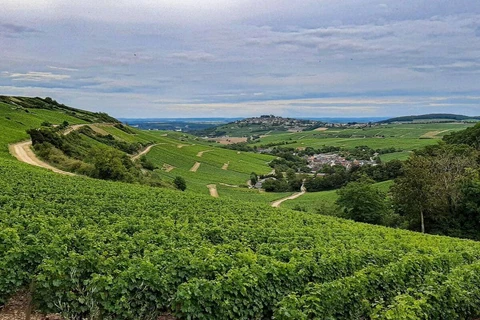
Where the Loire does add structure is at the level of individual sites within certain appellations. Savennières now recognizes two enclaves, Savennières-Roche-aux-Moines and Savennières-Coulée-de-Serrant, both capable of carrying additional designation beyond the base appellation, with Roche-aux-Moines gaining Grand Cru status starting with the 2023 vintage, making it one of the newest Grand Cru sites in France. Quarts de Chaume, similarly, became the Loire’s first Grand Cru appellation for its botrytized sweet wines back in 2011. Sancerre and Pouilly-Fumé, by contrast, rely on informal recognition of specific lieux-dits and soil types (silex, caillottes, terres blanches) rather than any formal cru hierarchy, leaving producers to build reputation site by site much as in the Sud-Ouest.
Four Loire Valley Estates Worth Visiting
These four estates span the Loire’s core sub-regions and stylistic range: dry Chenin Blanc in Savennières, Cabernet Franc in Chinon, Sauvignon Blanc in Sancerre, and the broader Anjou countryside connecting them.
Château Pierre-Bise (Savennières, Anjou)
Pierre Papin bought this Beaulieu-sur-Layon property in 1959, and under his son Claude and now grandsons René and Christophe, it has grown into one of Anjou’s benchmark Chenin Blanc estates. The 45-hectare property spans Savennières, Coteaux du Layon, and Quarts de Chaume, and the family’s defining practice is refusing to blend across their 25 identified individual climats, vinifying each separately to preserve the character of schist, spilite, and sandstone soils that shift within meters of each other. The estate has farmed organically since 1976, among the earliest in the region to commit to that approach.
- Address: 1 impasse Chanoine de Douvres, 49750 Beaulieu-sur-Layon, France
- Contact: +33 (0)2 41 78 31 44, contact@chateaupierrebise.com
- Visiting: By appointment, Monday to Saturday, 10:00 to 12:00 and 14:00 to 17:30. Note that the estate is located at the lieu-dit Pierre Bise itself, a short drive outside Beaulieu-sur-Layon village, so confirm directions when booking.
Domaine Charles Joguet (Chinon, Touraine)
Charles Joguet, a trained painter and sculptor, took over his family’s Chinon vineyards in 1957 and, unusually for the time, insisted on vinifying distinct parcels separately rather than blending or selling grapes to négociants, a philosophy that reshaped how the appellation thinks about terroir. Now run by the Genet family with winemaker Kevin Fontaine, the 39-hectare estate produces seven parcel-specific Cabernet Franc cuvées and one dry Chenin Blanc, offering a genuine tasting tour through Chinon’s varied soils in a single visit. Much of the wine ages in a 15th-century underground cellar near Marçay.
- Address: 3 rue de la Vienne, Sazilly, 37220, France
- Contact: +33 (0)2 47 58 55 53, contact@charlesjoguet.com, bookable through charlesjoguet.com
- Visiting: Monday to Friday, 10:00 to 13:00 and 14:00 to 18:00; Saturday, 10:00 to 18:00 from April to October, and by appointment in winter. Booking ahead is recommended even during scheduled hours.
Domaine Vacheron (Sancerre, Upper Loire)
Now in its fifth generation, Domaine Vacheron is run by cousins Jean-Dominique and Jean-Laurent Vacheron, who have farmed the estate’s 70 hectares biodynamically since 1997, among the earliest and most committed conversions in the appellation. Vineyards cluster tightly around the hilltop town of Sancerre itself, split roughly evenly between flinty silex soils, which give the Sauvignon Blanc a distinctive smoky character, and softer limestone and clay. The estate vinifies numerous individual lieux-dits separately, including the celebrated Les Romains and the ungrafted, pre-phylloxera-style vines of L’Enclos des Remparts, and also produces a well-regarded Pinot Noir red under the Sancerre Rouge designation.
- Address: 1 rue du Puits-Poulton, 18300 Sancerre, France
- Contact: +33 (0)2 48 54 09 93, vacheron.sa@orange.fr
- Visiting: Tasting and direct sales Monday to Friday, 08:30 to 12:00 and 13:30 to 17:00. Guided oenotourism visits by appointment run around €110 per person for a ten-wine tasting; contact the estate directly to book, as this goes well beyond the standard walk-in tasting.
Domaine de la Bergerie (Anjou-Saumur)
Rounding out the region’s diversity, Domaine de la Bergerie farms across Anjou and the Coteaux du Layon, producing the fuller range the region is known for: dry and off-dry Chenin Blanc, Cabernet Franc-based reds, and sweet Layon whites, all from vineyards worked biodynamically. It’s a useful stop for visitors wanting a single estate that demonstrates Anjou’s stylistic breadth in one afternoon rather than specializing narrowly the way Pierre-Bise does. As with many smaller Anjou producers, direct contact ahead of a visit is essential, since hours vary seasonally and the tasting room is not staffed continuously.
- Address: La Bergerie, 49380 Champ-sur-Layon, France
- Contact: Best reached through the Anjou wine tourism office (anjou-vignoble.com) or by phone ahead of a planned visit, as direct contact details vary by season
- Visiting: By appointment; confirm current hours before traveling, particularly outside the April to October high season.
Where to Buy Loire Valley Wine
Retail availability for the Loire is stronger and more consistent than for the Sud-Ouest, though it still varies by producer.
Decántalo carries Domaine Charles Joguet across several cuvées, including Les Charmes and Les Petites Roches in both red and white, making it the most complete single source among the three preferred retailers for Chinon specifically.
Colaris stocks Domaine Vacheron’s Sancerre Rouge Belle Dame, the estate’s Pinot Noir bottling, alongside a broader Sancerre selection from producers like Domaine Pellé. Vacheron’s white Sancerre bottlings were not confirmed in current Colaris stock at the time of writing, though smaller Dutch specialists including De Bruijn in Wijnen and Leirovins carry the fuller range, including the flagship Les Romains and single-vineyard Guigne-Chèvres.
Château Pierre-Bise and Domaine de la Bergerie were not confirmed in stock at Wijnbeurs, Colaris, or Decántalo at the time of writing. For Pierre-Bise, the estate sells directly through chateaupierrebise.com, and its wines appear periodically through specialist Loire importers; this is worth checking directly rather than assuming unavailability extends to every European retailer. WirWinzer and Drinks & Co remain useful fallback aggregators, particularly for Muscadet and Vouvray, which tend to have broader general distribution than smaller Anjou producers.
Food Pairing
The Loire’s range of styles makes it one of the most versatile regions at the table, and pairing here follows sub-region as much as grape.
Muscadet, briny and bone-dry, is the textbook match for oysters and other raw or lightly cooked shellfish, its sur lie texture giving it just enough weight to stand up to the food without overwhelming it. Sancerre and Pouilly-Fumé, with their citrus and mineral character, pair naturally with goat cheese, particularly Crottin de Chavignol produced a few kilometers from Sancerre itself, as well as with fresh herbs, asparagus, and simply prepared white fish.
Chinon and other Cabernet Franc-based reds have enough acidity and moderate tannin to handle a wide range of dishes, from roast chicken and charcuterie to grilled vegetables, and their leafy, red-fruited character makes them notably food-flexible compared to more tannic reds.
Dry Savennières, with its density and minerality, rewards richer pairings than most dry whites, standing up well to roast pork, mushroom dishes, or aged hard cheeses. Sweet Loire wines, whether Vouvray Moelleux or Coteaux du Layon, are natural partners for blue cheese, foie gras, or fruit-based desserts, their high acidity keeping the sweetness from feeling heavy.
Getting There and Planning Your Trip
Tours and Angers are the two most useful base cities for a Loire wine trip, both roughly an hour by TGV from Paris, making the region genuinely feasible as a rail-based itinerary rather than requiring a car from the outset, unlike Bordeaux or the Sud-Ouest. From Amsterdam or Rotterdam, flying into Paris and connecting by train is generally the most practical route, with total travel time typically under five hours door to door.
Tours sits almost exactly halfway between Sancerre in the east and Nantes (for Muscadet) in the west, making it a sensible central base if trying to cover multiple sub-regions. Chinon and Saumur are both easy day trips from Tours, roughly 45 minutes by car or accessible by regional train. Sancerre, further east, is better reached via Bourges or by a roughly two-and-a-half- to three-hour drive from Paris; it makes sense as either its own short trip or the final stop on a longer Loire itinerary heading east.
A car becomes genuinely useful once venturing beyond the main towns, since many individual estates, particularly in Anjou and around Chinon, sit down narrow country roads with no public transport access. Spring brings blossoming countryside and the famous Loire château gardens into bloom, while September and October offer harvest activity, particularly worth timing a Sancerre or Chinon visit around if the timing works. Summer remains the most popular season given the region’s château-touring appeal, so booking winery visits ahead is worth doing regardless of month.
Cycling is also a genuinely practical way to see parts of the Loire, particularly the Anjou-Saumur stretch, where the Loire à Vélo route runs largely flat alongside the river and connects several villages with wine estates directly on or near the path. It’s a slower, more deliberate way to move between tastings than driving, and one that suits the region’s unhurried character better than a packed multi-château itinerary would.
Frequently Asked Questions
What makes the Loire Valley different from other French wine regions? The Loire is defined by geographic range rather than a single dominant style. A 600-mile stretch of river produces everything from bone-dry Muscadet near the Atlantic to smoky Sauvignon Blanc in the Upper Loire and sweet, botrytized Chenin Blanc in Anjou, often within the same broad region.
Is Sancerre always white wine? No, though white is by far the most common style. Sancerre also produces small amounts of rosé and red wine, both made from Pinot Noir, which is planted on some of the appellation’s limestone and clay plots alongside the dominant Sauvignon Blanc.
What’s the difference between Muscadet and other Loire whites? Muscadet is made exclusively from Melon de Bourgogne in the Pays Nantais, near the Atlantic coast, and is typically bone-dry and saline. Other Loire whites, from Sancerre’s Sauvignon Blanc to Savennières’ Chenin Blanc, come from different grapes and sub-regions further inland, with distinctly different mineral and aromatic profiles.
Can Chenin Blanc be both dry and sweet from the same region? Yes, and this is one of the Loire’s defining features. Producers in Anjou-Saumur, including several profiled in this guide, often make both styles from Chenin Blanc, sometimes from adjacent or even overlapping vineyard plots, depending on how the grapes are harvested and whether botrytis (noble rot) develops that season.