Mittelrhein Wine Region: Riesling, Castles and Hidden Vineyards Along the Rhine
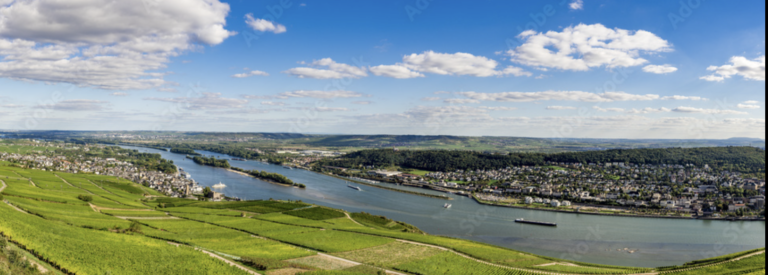
There is a stretch of the Rhine between Bingen and Bonn where the river narrows, the hills close in, and vines grip the rock at angles that would give most viticulturalists pause. This is the Mittelrhein, one of Germany’s smallest wine regions, one of its most visually dramatic, and arguably its most underrated. The name translates simply as “Middle Rhine,” but that modesty does little justice to what you find here: fortress ruins perched above terraced slate vineyards, medieval towns that feel largely unchanged since the 16th century, and Rieslings of a precision and mineral cut that routinely outperform wines from regions with far bigger reputations.
For serious wine enthusiasts, the Mittelrhein has long been a whispered reference. Critics in the know name its top producers alongside those from the Mosel and Rheingau, yet the wines rarely appear on restaurant lists outside Germany. The reasons are not hard to understand: the region covers only around 470 hectares, most estates are tiny family operations with no marketing budgets, and the sheer difficulty of farming these near-vertical slopes keeps volumes low. But that is also exactly what makes coming here worthwhile.
This guide covers the geography, the wines, four estates that justify making the trip, bottles you can order online from retailers including Decantalo, and practical advice for planning your visit.
What Makes the Mittelrhein Different
The wine-growing region runs for roughly 120 kilometres on both banks of the Rhine, from the village of Oberdollendorf near Bonn in the north down to Bingen in the south where it meets the Rheingau. The heart of quality production sits between Koblenz and Bacharach, in the section designated as the UNESCO World Heritage Upper Middle Rhine Valley since 2002.
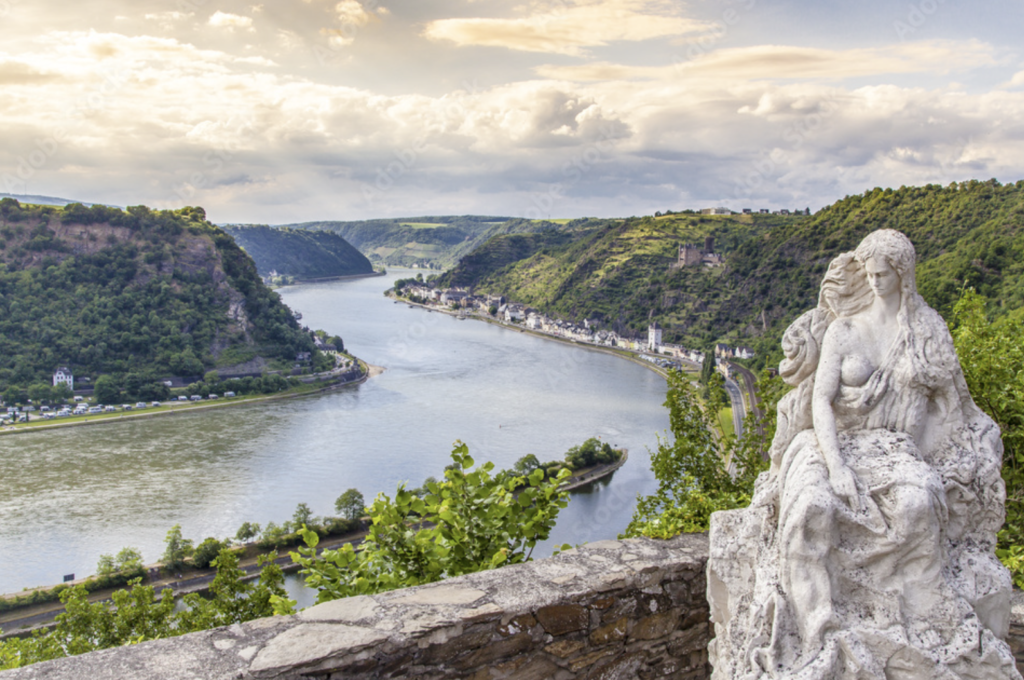
More than 80 percent of the vineyards here are planted on slopes with a gradient of at least 30 percent. Some, like those in the Bopparder Hamm, the great curved bend of the Rhine south of Boppard, reach gradients of 70 percent. There is no mechanisation possible on terrain like this. Every bunch of grapes is picked by hand. Every vine is tended by people walking the slope with secateurs and a bucket. This makes the economics of winemaking here punishing, which is why vineyard area has contracted by roughly 40 percent over the past 30 years despite the quality being undeniable.
The Geology and Soils
The bedrock beneath the Mittelrhein is what separates it from almost everywhere else in the wine world. The Rhine carved its course through the Rhenish Slate Mountains over millions of years, leaving exposed cliffs and deep valley floors lined with Devonian slate, greywacke, quartzite, and scattered loess deposits. The dominant soil type is weathered slate. Dark, thin-skinned, heat-retaining, and fast-draining. These soils are the engine behind the region’s signature minerality.
Slate absorbs warmth during the day and releases it slowly through the night, acting as a natural temperature moderator that extends the ripening season well into autumn. The Rhine itself functions as a vast heat reservoir, reflecting sunlight back onto the vineyards and protecting them from sharp frosts. This combination- steep south-facing slopes, dark heat-retaining soils, and a river-moderated microclimate- gives the Mittelrhein a growing environment that defies expectations for a wine region this far north.
The Grape Varieties
Riesling dominates with somewhere between 64 and 68 percent of all planted area, depending on the data source. This is Riesling country in the same total sense that Burgundy is Pinot Noir country, and the best producers treat the variety with corresponding single-mindedness.
Spätburgunder (Pinot Noir) accounts for around 10 percent of plantings and has been producing increasingly compelling results, particularly from estates like Weingart and Ratzenberger. Weissburgunder (Pinot Blanc), Müller-Thurgau, and Grauburgunder (Pinot Gris) make up most of the remainder, but remain secondary.
The Rieslings of the Mittelrhein have a distinct profile: high natural acidity, citrus-forward aromatics that lean towards green apple, Mirabelle plum, and white grapefruit, and a mineral texture that often reads as wet slate or flint rather than the more obviously fruity profiles found in neighbouring Rheinhessen or Pfalz. Compared to Mosel Rieslings, they tend to be a little more austere and taut, with less of the classic petrol note but more grip. They age well.
The Two Districts: Loreley and Siebengebirge
The Mittelrhein is divided into two Bereiche, Loreley in the south and Siebengebirge in the north. Loreley covers the most prestigious part of the region, stretching from Lorchhausen near the Rheingau border up through Bacharach, Oberwesel, St. Goarshausen, and Boppard. This is where you will find the highest-rated individual vineyard sites and the estates covered in this guide.
The Loreley rock itself, a 132-metre-high slate cliff at St. Goarshausen, is one of Germany’s most visited natural landmarks and gives its name to the district. The Rhine narrows dramatically here, creating fierce currents that inspired the legend of a siren who lured sailors onto the rocks. Today the view from above the Loreley looking down the river bend is one of the most photographed scenes in the country.
Siebengebirge in the north, clustered around Königswinter near Bonn, is smaller and less visited. The volcanic soils here produce wines with a different texture, but output is limited, and few wines from this area make it far beyond regional markets.
The Key Vineyard Sites
Understanding the Mittelrhein’s quality hierarchy means knowing a handful of individual vineyard names. These are not just marketing designations; they represent genuinely distinct terroirs with decades of documented differences in flavour profile and ageing potential.
Bopparder Hamm is the region’s most famous site and the largest contiguous vineyard in the entire Mittelrhein, spread across the inside bend of the horseshoe-shaped loop the Rhine makes at Boppard. It contains four sub-sites classified by the VDP as Grosse Lage: Feuerlay, Mandelstein, Ohlenberg and Engelstein. The name “Hamm” derives from an old word for the curved inner bank of a river. Wines from here tend to be slightly richer and fuller than those from the southern Bacharach sites, with tropical fruit alongside the mineral structure.
Bacharacher Wolfshöhle and Steeger St. Jost are the two flagship sites around Bacharach in the south. Both are VDP Grosse Lage classified, and both produce Rieslings of remarkable precision. St. Jost sits in a narrow side valley behind the village of Steeg, protected from wind and with slate soils that give wines a taut, laser-sharp quality. Wolfshöhle delivers something slightly broader and deeper, particularly in riper vintages.
Bacharacher Hahn is the historic home vineyard of Weingut Toni Jost, planted largely on Devonian slate at gradients that require individual vine management. The wines from this site have been collected internationally for decades.
Four Wineries Worth the Journey
Weingut Ratzenberger, Bacharach
If you are visiting the Mittelrhein for the first time and can only stop at one estate, Ratzenberger makes a strong case for being that estate. The winery sits in the beautiful narrow valley above the old town of Bacharach, surrounded by some of the most dramatically beautiful vineyard terrain in Germany. The family purchased what was already a 300-year-old estate in 1956, and third-generation winemaker Jochen Ratzenberger has been running operations since the 1990s.
The estate holds 20 hectares, with a significant portion planted on old vines across three VDP Grosse Lage sites: Bacharacher Wolfshöhle, Steeger St. Jost, and Bacharacher Posten. In 2017 Ratzenberger expanded boldly by taking on an additional ten hectares of steep slope in the Schloss Fürstenberg site, a move that initially raised eyebrows in the region but has since produced wines that have become estate staples.
What distinguishes the Ratzenberger style is clarity and precision. Jochen is not chasing power or extraction; these are wines built on mineral finesse and the tension between fruit and acidity. The Grosse Gewächse from Wolfshöhle and St. Jost consistently rank among the region’s best, and the estate also produces excellent sparkling wines aged on the lees for at least 30 months.
The winery conducts tastings in its spectacular vaulted historic cellar and sells direct from the estate. Holiday apartments are available for those who want to make a longer stay of it. Prior contact is advisable before visiting.
Address: Blücherstraße 167, 55422 Bacharach
Website: www.weingut-ratzenberger.de
What to taste: Steeger St. Jost GG Riesling trocken, Bacharacher Wolfshöhle Riesling Auslese
Weingut Toni Jost, Bacharach
Located a few minutes’ walk from the centre of old Bacharach, Weingut Toni Jost is one of the Mittelrhein’s most storied names. The family has been farming vineyards in and around Bacharach for over 180 years, and across five generations their focus has remained almost single-mindedly on the Hahn vineyard, a VDP Grosse Lage site that the family has accumulated to the point where they now farm almost the entire classified area.
The current winemaker is Cecilia Jost, granddaughter of the Toni for whom the estate is named, and her approach brings an energy and precision to the range. Tastings take place in a beautifully preserved historic tasting room and offer a proper survey of how a single vineyard can be interpreted across different Prädikats, from bone-dry through to Auslese and the extraordinary sweet rarities.
The Hahn produces wines with a distinctive style: aromatic, fine-boned, and mineral, with a naturally fruit-forward character that makes them accessible young while rewarding extended cellaring. The VDP status of the wines and the quality-to-price ratio consistently impresses visitors and critics alike.
Tastings can be booked in advance, including through booking platforms that offer options in English, useful for international visitors. The estate also runs seasonal accommodation and a restaurant.
Address: Hahnenhof, Oberstraße 14, 55422 Bacharach
Website: www.tonijost.de
What to taste: Bacharacher Hahn Riesling Spätlese, Devon S Riesling Spätlese trocken
Weingut Florian Weingart, Spay
Florian Weingart operates what might be the most charming tasting experience in the Mittelrhein. The family estate in the riverside village of Spay is small; Florian’s father converted it from a mixed farm to a pure winery in the 1960s, and it remains a tight, highly personal operation. But within that scale, the quality and consistency are remarkable.
The estate farms vineyards in the Bopparder Hamm across four of its sub-sites, including the prestigious Feuerlay, Mandelstein, and Engelstein locations. Florian works with minimal intervention, following sustainable and organic practices, and the wines reflect that commitment in their transparency and site-specificity. Falstaff’s wine guide has awarded the estate recognition in successive editions, with critics noting that even the entry-level estate Riesling shows the mineral richness of the region at an accessible price point.
The tasting experience here is genuinely different. Rather than a traditional Verkostungsraum, Florian installed what he calls a “tasting wagon”, a beautifully converted wood-panelled construction wagon at the foot of the In der Zech vineyard, with a terrace and a large oak table that seats up to twelve. The atmosphere is relaxed and conversational. It is open Monday to Friday from 14:00 to 18:30, and Saturday from 11:00 to 18:30, and Florian has been known to offer spontaneous cellar tours to interested visitors.
The Riesling and Spätburgunder range covers everything from delicate Kabinett to structured Grosses Gewächs. The half-dry style Rieslings here are particularly worth attention — Weingart is one of the few producers making a serious case for the feinherb category.
Address: Peterspay 1, 56322 Spay
Website: www.weingut-weingart.de
What to taste: Bopparder Hamm Feuerlay GG Riesling trocken, Spätburgunder trocken
Weingut Matthias Müller, Spay
Just down the road from Weingart in Spay sits another estate that represents the Bopparder Hamm at its finest. Matthias Müller farms the Ohlenberg, Mandelstein, Feuerlay, and Engelstein sites with meticulous attention to terroir, and the estate’s position as one of the region’s VDP members signals the quality level on offer.
The Grosses Gewächse from Müller are among the most age-worthy wines in the Mittelrhein. The 2023 Boppard Hamm Mandelstein Riesling GG received a pre-release score of 93 to 95 points from Falstaff, with notes of fine smoke, flint, violet, nectarine, and Mirabelle plum, backed by a palate that showed energy and slate spice in a long, dry finish. The 2024 Feuerlay GG shows intense tropical fruit aromas, mango, grapefruit, Mirabelle, alongside the characteristic herbal backbone and positive acidity that defines wines from this curve of the river.
The estate also produces sweet wines of real distinction. The 2023 Bopparder Hamm Mandelstein Riesling Trockenbeerenauslese received a Falstaff score of 97 points, an extraordinary result that puts it in the company of the world’s great botrytis wines.
For visitors, Matthias Müller offers tastings by appointment at the estate on Mainzer Straße in Spay. The combination of cellar visit and tasting through the range, from entry-level estate wines to Grosse Gewächse, gives a thorough understanding of what the Bopparder Hamm can achieve across a range of styles and vintages.
Address: Mainzer Straße 45, 56322 Spay
Website: www.weingut-matthiasmueller.de
What to taste: Bopparder Hamm Mandelstein GG Riesling trocken, Bopparder Hamm Feuerlay GG Riesling trocken
Recommended Wines to Buy Online
For those who cannot make the trip to the Mittelrhein immediately, or who want to cellar a few bottles before visiting, the selection from online retailers is more accessible than many assume. Decantalo carries Mittelrhein wines and is one of the few specialist platforms with genuine stock from the region.
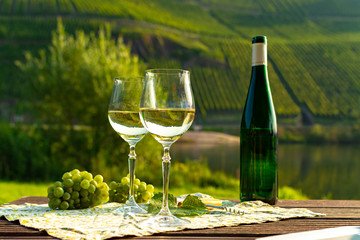
Ratzenberger Caspar R Riesling – Available at Decantalo
The Caspar R is the estate wine from Ratzenberger, blended from multiple parcels on the crumbling Bacharach slate and fermented in stainless steel to preserve freshness. The 2023 vintage received 90 points from Falstaff, with a tasting note describing slate, green apple, Mirabelle plum, apricot, and quince on the nose, and a fine interplay of residual sweetness and juicy acidity on the palate with real length. At the entry level for the estate, this is the wine to reach for if you want an honest introduction to the Mittelrhein at an approachable price.
Decantalo also stocks the Ratzenberger Bacharacher Riesling Trocken — a dry estate wine from south-facing slate terraces near Bacharach, with Parker scoring of 92 points for the 2022 vintage. Both wines are available to order directly via www.decantalo.com.
Wines Direct from the Vineyard
For the most direct access to Mittelrhein wines, the producers themselves sell direct from their estates and some ship across Europe:
Weingut Matthias Müller sells its full range, including the Bopparder Hamm Feuerlay GG Riesling trocken and Mandelstein GG Riesling trocken via its own webshop at www.weingut-matthiasmueller.de. These are wines that appear at around €26 to €34 for the Grosses Gewächse, serious wines at prices that would be considered bargains for equivalent quality from the Mosel or Rheingau.
Weingut Florian Weingart takes orders directly and ships within Germany and to various European destinations. Contact the estate via their website at www.weingut-weingart.de or call ahead to arrange an order alongside a visit.
Weingut Toni Jost operates both cellar door sales and direct shipping for their VDP range, including the Bacharacher Hahn Riesling in various Prädikats. Their website at www.tonijost.de has current availability.
Weingut Ratzenberger sells both direct from the estate and through specialist importers in several European markets. The Steeger St. Jost and Wolfshöhle single-vineyard wines occasionally appear on the lists of German wine specialists in the Netherlands and Belgium, and the Caspar R estate wine has the widest international distribution via Decantalo.
Getting There and Around
The Mittelrhein is genuinely easy to visit from the Netherlands, Belgium, or Luxembourg. Bacharach is roughly three hours by car from Amsterdam or two hours from Brussels, with Koblenz accessible via high-speed rail connections and Bacharach reachable by regional train from there.
The Rhine is served by passenger ferries and river cruise ships throughout the season (roughly April to October), and one of the most atmospheric ways to move between villages- Bacharach, Oberwesel, St. Goarshausen, Boppard- is by the regular Rhine ferry service. There is also an extensive network of hiking trails, including the legendary Rheinburgenweg (Rhine Castle Trail), which links the ridge above the river from estate to estate.
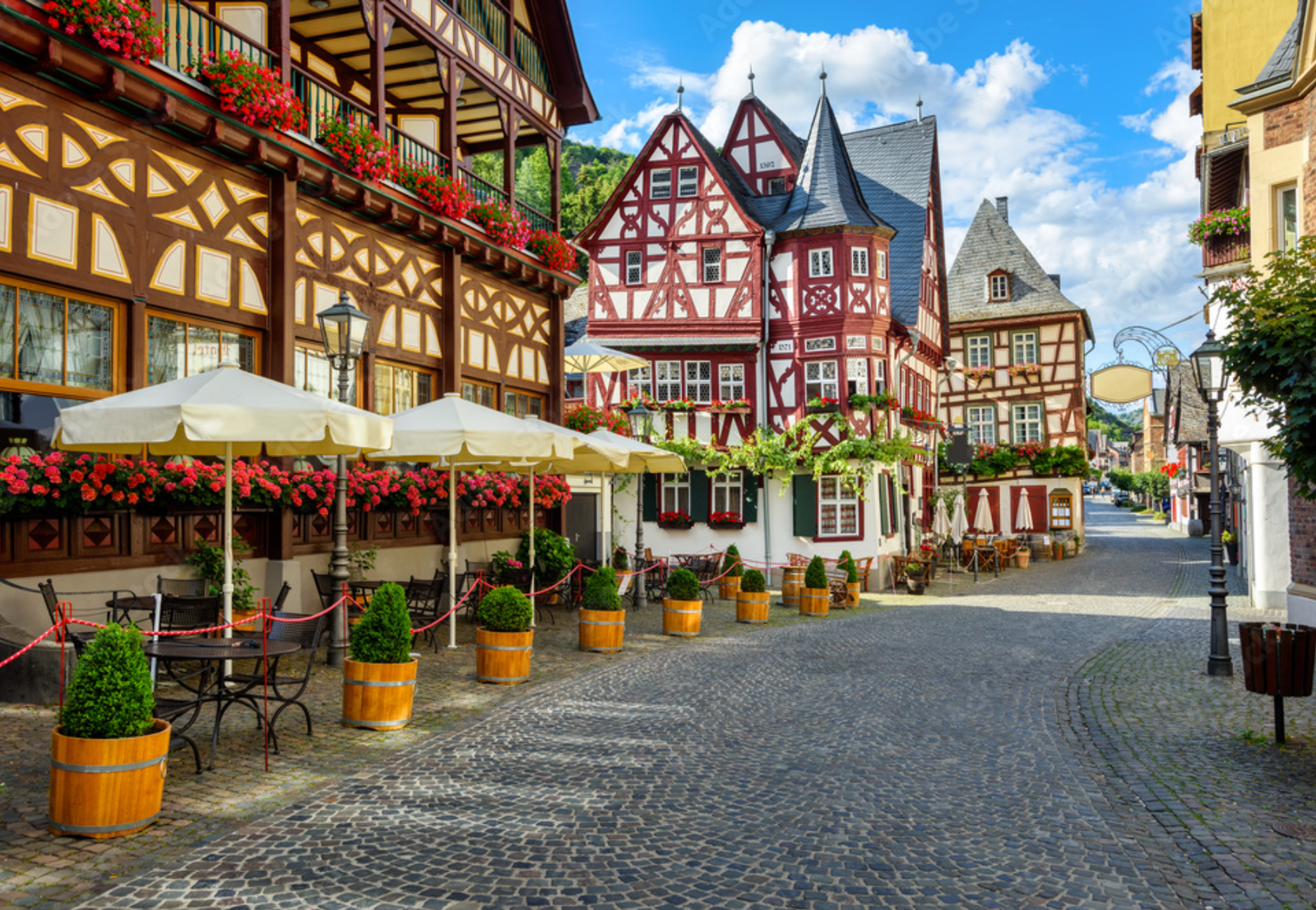
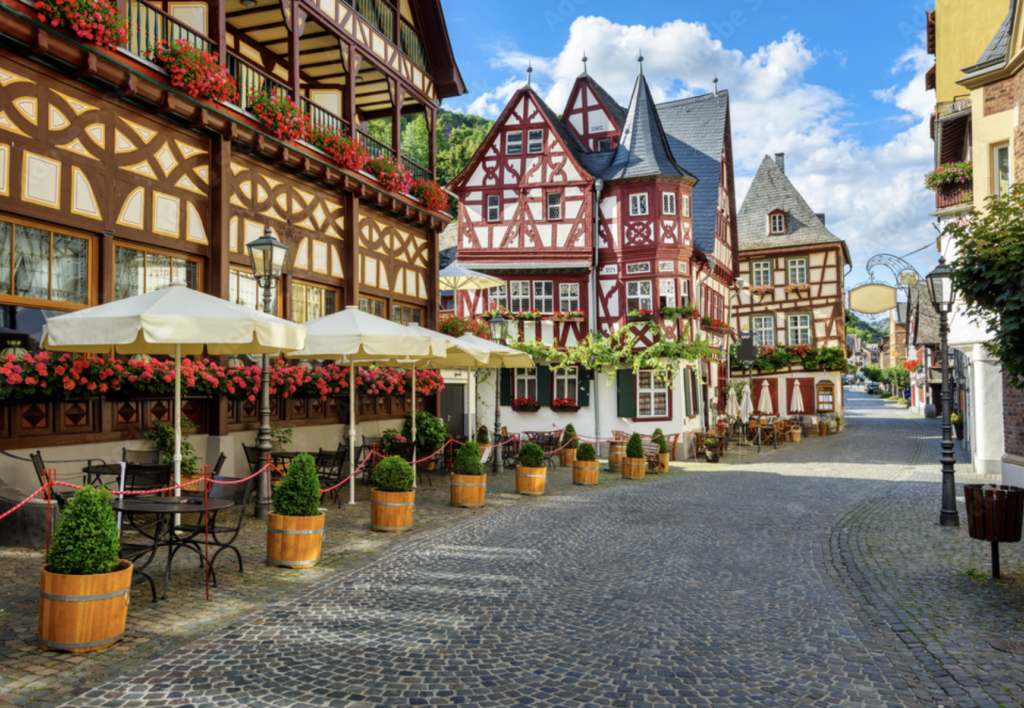
The small medieval towns of the region are worth time in themselves. Bacharach in particular is one of the best-preserved medieval villages in Germany, its half-timbered old town enclosed by original city walls that you can still walk. The Burg Stahleck castle above the town, now a youth hostel, offers views across the vineyards that are genuinely arresting. In Boppard, the cable car (Sesselbahn) up the hill above the Bopparder Hamm vineyards gives you a bird’s-eye view of the famous river bend that has inspired painters and writers for centuries.
Where to Stay
For wine enthusiasts, accommodation in Bacharach and Boppard puts you within walking distance of multiple estates. The Hotel Altkölnischer Hof in central Bacharach is a well-regarded three-star option with its own wine list that includes local producers. Weingut Ratzenberger also offers holiday apartments for those who prefer to stay on site.
For something grander, Schloss Rheinfels in Sankt Goar, a castle complex above the Loreley stretch, has been converted into a four-star hotel with a wellness centre and restaurant overlooking the Rhine. Burg Reichenstein near Trechtingshausen, just south of Bacharach, is another castle hotel highly regarded for both rooms and restaurant.
When to Visit
Harvest in the Mittelrhein typically runs from late September into October and occasionally November for late-harvest styles. This is the most atmospheric time to visit; the slopes are busy with pickers, the light is golden, and many estates hold open days or tasting events. The Rhein in Flammen (Rhine in Flames) festival in September lights the river with fireworks reflected off the water, and the harvest festivals in Bacharach and Boppard draw local producers together.
Spring is less predictable weather-wise but rewards visitors with flowering vineyards and quieter tasting rooms. Summer brings Rhine cruise crowds to the main towns, but the wineries themselves remain personal and uncrowded.
For the most substantive visits to estates, September, October, and early November give you the chance to discuss the just-completed harvest with winemakers who are genuinely energised by what they have made. Many producers, including Weingart, hold annual vintage presentation events in May for the previous year’s wines, which are excellent occasions for tasting systematically through a full range.
A Region Worth Paying Attention To
The Mittelrhein’s low profile relative to its quality is, in one sense, a problem for the region. Vineyards continue to be abandoned because the economics of steep-slope viticulture are unforgiving when wines do not command prices that justify the labour. But for the wine enthusiast willing to look beyond the better-marketed German regions, it is an opportunity. The best Rieslings from Ratzenberger, Weingart, Müller, and Toni Jost would hold their own in blind comparisons with wines twice their price from more famous addresses.
The landscape alone would justify the trip. Sixty-plus castles, a UNESCO-protected gorge, medieval villages, and 120 kilometres of the most dramatic scenery in central Europe. With the added advantage that at almost every turn you can stop and taste one of Germany’s most precisely made white wines in the cellar that produced it.
For anyone serious about German Riesling who has not yet made the journey to the Mittelrhein, it should move near the top of the list.